


Three Trees, Kodiak, AK
I have this bluetooth gizmo for my car that allows me to use my iPhone hands-free. It acts as an FM transmitter so audio broadcasts through my car’s speakers. It also allows me to play any music I have on my iPhone, use Pandora, or any other audio service through my car stereo. The downside is that due to some FCC regulation changes a few years ago, they have limited the power of these devices, resulting in some slight static. It is better than most I have tried, but the static is still noticeable. It doesn’t make much of a difference when using it for the phone, but sometimes I do find it annoying when listening to music.
Last week I was listening to a limited edition, red vinyl only release called “Field Recordings” from Rocco DeLuca that I picked up when he was here in Detroit back in November 2010. (He is an incredibly talented guitar player and soulful singer, I recommend everyone check him out) Once I got the vinyl transformed to digital, I have been listening to it constantly on my computer, and then took it to my car. Well, the rip I did from the vinyl is crystal clear on my computer, but I was limited in clarity by the transmitter in my car.
At first, all I heard was the static. I was so annoyed. All the work I had done in getting a red vinyl LP into a high quality digital format had some how become “corrupted” by the transmitting device. But the more I listened, the more I became absorbed by just the music. After awhile, I was enjoying the music so much that I didn’t even notice the static anymore.
A similar situation happens to me frequently in the field while photographing. Static isn’t the hiss that I am hearing from a set of speakers, but a myriad of other things that affect me from being in the moment. Stress about getting to someplace on time, getting up late, not finding what I was hoping for, equipment troubles, worrying about weather, inner pressure to create something good, etc. are all static. Static that I believe prevents me from making photographs I would have otherwise seen without it.
Some things are simply beyond our control, and I suppose the first step in getting past them is recognizing that. Being able to pinpoint what is causing the static in the field is the first step in being able to see past it. Sometimes I will just sit down and relax, try to let whatever is causing the static to drift away. I have to remind myself that if I go home with nothing, at least I will have been there trying. I wish I was always able to get past it. It serves as a reminder that what goes into making images isn’t just the gear, the location, the subject, or being creative. Static is always going to be there in some form or another. Some days are easier to fight it than others.
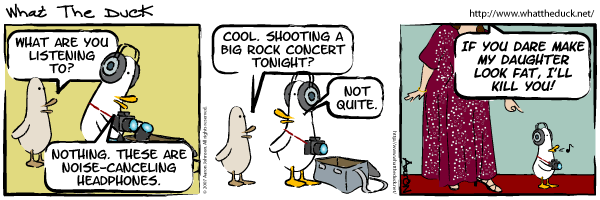
Edit: I just happened to notice this was a recent WTD worthy of including here… 🙂


Hey Mark –
Truer words were never spok… errr… typed. One of the ways that I try to deal with “static” is to arrive on location early whenever possible. It doesn’t always work, but many times it allows me to soak in the environment and really bond or become intimate with the place/subject. Spending this extra time outside helps me to filter out the extraneous material and static in my life. It also allows me time to really connect and (I feel) get a deeper understanding or meaning of what it is there that ‘moves me’.
Excellent post, and something we all deal with from time to time. I guess that is part of the challenge, and when you overcome that hurdle, that’s when the magic happens.
Beautiful image too Mark – wonderful lines and colors. Take care.
I try to do the same Dave – I think that is very sound advice.
Mark, I think that once you’ve achieved a certain level of learning the craft, it all becomes about your mental state. The “static” you refer to is anything that prevents one from letting go and experiencing what is around them. Only after letting go, can emotion and creativity take hold. Good stuff man.
Hey Paul… very true, and I came to the ultimate conclusion that I am not a Jedi yet.
Well said, Mark. Sometimes, for me anyway, just grabbing the camera bag and getting out eliminates the static, or at least cuts it down a bit. Nice post. Great shot.
That’s also a start for me Ken. Thanks.
Good post. I think it takes quite a bit of practice to be able to shut out the static when taking pictures. You may not know it at the time (because if you’re thinking about it that in itself is static), but afterward, when you’ve lost all sense of time and place, you know you did it.
Well put. I definitely need practice.
When I go out with expectations and goals the noise of the static is deafening. Like Colin, I mostly work without pressure to produce. When I am shooting for a client, I have to begin preparing myself the day before if I am going to have a fighting chance against the noise in my head. Expectations emit dreadful static.
The photo here is so wonderfully alive and inviting.
Thank you for your thoughts Anita. I wish I could go out expectation-free. My time in the field seems so limited, that I tend to put a little pressure on myself that I should come back with something to show for it. It is not healthy, and I am trying to change that. But so much else can contribute to the static – gunshots, street noise, anything that spoils the peacefulness of being in the middle of nowhere.
Mark, today, I went camera in hand for a walk in the woods at a local park. My mind was full of last weeks activities, next weeks goals, and how swiftly today, the last day of the weekend, was passing by. It was so bad about half way into my walk, I stopped and let the camera hang from my neck, closed my eyes with arms to my side and did nothing but listen. After a few quiet moments I opened my eyes and truly looked around — an exercise I’ve used before.
I was amazed reading this post about noise. That what all those thoughts were interfering with my being in the present, experiencing the moment — noise. I haven’t looked yet but I’d bet I took better photographs in that second half of my walk.
An enjoyable post and a beautiful photo. The color of the growth in the background is so rich and warm.
From now on Earl, you can refer to me as Miss Cleo. 🙂 Hope those photos are free of that static interference!
All the readings I find on prayer and meditation mention the noise, the chatter of roaming thoughts in our heads. I experience it anywhere, reading, listening to someone in a conversation, shooting, etc. The more we practice the better we are at filtering out what is inspiration and what’s not (static). Good post!
I agree Monte – it does take practice. Can’t say I am that good at it yet, especially when there are large amounts of chatter. I have been tempted to try meditation.
Re your last paragraph: I have been there so, so many times. I used to beat myself up about it all the time and I had so much expensive kit! I was in so many great places but I continually labelled my outings as “failed”. You are right about “noise”, but it’s all about relaxing and learning to go with the “flow”, and that’s where I don’t agree with your last sentence; it’s best not to “fight it”! These days (perhaps it’s because I’m older than I was and just amateur)I don’t place myself under any expectations, I just go out with a couple of lenses (the ones that take my fancy on that particular day), and let myself respond to the environment. It amazes me how many images I come home with now compared to how it used to be, and if I don’t, then that’s OK too. For me the key has been simplifying and relaxing my mind.
Colin, thanks for your thoughts. I also have simplified what I take with me lately, and it does help some. There is certainly some benefit in leaving the opportunities to serendipity!
I agree, Mark.
Further, “fighting static” also applies to viewing photos. We can (and should) be more focused on the substance than minor issues with noise, etc.
Agreed Mike. That is one of my pet peeves of judges / critiques.