


Yearly favorites were harder to choose this past year simply because there weren’t many exposures overall. I imagine that’s an inherent problem with these yearly favorites posts. It emphasizes product over process in a culture that demands constant output. It can leave one with self-imposed judgment of what a “good crop” is. However, as with the rotation of our planet and our four seasons, patterns of life and nature are just points on a looping circle rather than a straight line of peaks and valleys. What better time to do this than in the winter, when daylight is shorter, trees pull back energy into their roots and reveal their structure, and rest builds endurance.
That’s what I have come to define these Yearly Favorites posts as: points on a circle, taking a little time to scribble some notes about the path traveled. The photos conveniently mark some waypoints along this journey, but are by no means meant to be any measure of accomplishment other than just movement along the circle. Many waypoints have no photos at all to define them, but may very well be key in defining the next one that does.
Last year, it was pretty exciting to see my first piliated woodpecker in the woods behind us and hear its unique call. I wasn’t sure what the call sounded like, but when I heard it, knowing it was different than the many other woodpeckers we have, I thought “Wait a minute… is that a pilliated….?” Not really Woody the Woodpecker, but you can hear similarities! So, Merlin app to the rescue, and finally confirmed with a visual. Not a single photo of it, not even a try – but nonetheless rewarding and memorable. My wife and I earned (and exceeded) enough educational credit hours to maintain our Michigan Master Naturalist certifications for another two years. I kept up with seasonal monitoring and documentation of three local vernal pools that still remain the only confirmed spots in the county. There are certainly more, just a lack of people and interest to find and keep track of them.
That is a problem not only with these highly important ecosystems, but with most of everything in the environment we live in. A quote my wife found resonated strongly with me. Every day, we are losing biodiversity and habitats, and we likely do not fully understand the totality of what is being lost or personally experience the consequences of our decisions. It makes you think… “wow, we really are just kinda wingin’ it, aren’t we?“
“In the end we will conserve only what we love, we will love only what we understand, and we will understand only what we are taught.”
~ Baba Dioum, 1968
International Union for Conservation of Nature
The year 2025 marks “Volume 19” of Yearly Favorites. As with most great quotes, they are powerful because they characterize these grand concepts in a very simple way. While I struggled to formulate this particular volume, I realized that all of these photos could be binned into these three simple aspirations: conserving what we love, seeking to understand more, and learning.
Shoreline Ice Sheets, Campau Bay, Lake St. Clair, MICHIGAN

Lake St. Clair remains a go-to destination for winter photography, if I can muster the motivation to get out there before sunrise on cold mornings. Despite having been there only once in 2025, I am familiar enough with the place to focus my time. Sunrises here can be quite spectacular over an ice-covered lake, and the wind brutal and biting. On this day in March 2025, there was a lot of open water except for the shoreline bays and, as I recall, a sunrise that was rather – meh.
Ice sheets that pile up along the shoreline always make for some interesting exploration, and in particular, how they transmit light. The sun is rising off the top-right corner of this photo, yet you can see how light is penetrating through the ice sheets, depending on their angle relative to the sun. Portraying this in black & white seemed to emphasize those characteristics and the shapes. I liked the blackness of the open water, which not only offered a sense of place but also seemed to heighten the tension via contrast with the glowing edge of the center ice sheet.
Wind Wave, Silver Lake Dunes, MICHIGAN

Exposed in 2024, but this aerial abstract wasn’t worked on and finished until later in 2025. It was one of those images I was drawn to when I saw it framed on the screen of my drone controller, but as often happens, it didn’t have the same resonance when I looked at it later. I mark these for follow-up, recognizing sometimes you just aren’t in the right mindset or ready to engage with certain photos. Fast-forward nearly a year, and I was poking around in my archives, playing with some images I’d marked to follow up on later. This happened to be one of them. It isn’t super obvious, but sand is blowing across this dune – which is seen 40m (~120 ft) below in this aerial abstract. The shapes and patterns carved by prevailing winds off of Lake Michigan and recent precipitation.
Plum Brook Wetland in Autumn

Another photo exposed in 2024, finished in 2025: a parcel of land that was cleared farmland in 1949, then slowly returned, and ultimately became city-owned as a 90-acre preserve of wetlands and returning lowland forest. The land was part of a bargain, as I understand, as the neighboring wetlands were destroyed for subdivision development around 2002-2005, including one ironically named “The Preserves.” I never understood why developers do this, name their projects after what used to be there and was destroyed, but thankful to have this close to home because 90 acres is much better than 0 acres. Autumn light was beautiful this morning, offering some nice aerial views of a meandering Plum Brook flowing through it.
Ostrich Fern and jewelweed

I wrote a previous post about this image, so I don’t have a lot more to say other than it made the cut. Using the EPA ecoregion designation here makes it sound a lot fancier than “our backyard.” Heh. Both are native plants to this area – we planted the ferns, but the surrounding jewelweed (also called touch-me-nots for their seeds that explode – which is also fun to play with) came in all on its own, and we just let it grow. It really seems to like this spot in our yard.
Emerald Waters of Lake Huron

This image was made (er, exposed) on a warm August day when we went to this beach to snorkel and look for colorful rocks. On a previous visit, my wife convinced me to go, which resulted in some neat finds and a lot of fun. We kinda forgot to check the lake wave conditions returning again. The surf made us cancel the snorkeling, but hanging around a while to grab some photos with my iPhone was still an option. I liked this beach scenic enough to just experiment with it later, emphasizing the emerald qualities of Lake Huron and a calming yet dynamic aesthetic. A Great Lakes freighter can be seen on the horizon in the distance on the right side.
RIVERLAND PARK TREES

This parcel of land in our city is caught up in a local controversy over a federally funded land purchase, advertised as a park and then sold to a favored local developer for an apartment building, with a sales pitch obscuring the extent of the environmental destruction that will occur. The extra salt in the wound is that it was pushed through just before a tax increase, partially to pay for the acquisition of more green space to… “protect it from private development.” No, this isn’t a story from The Onion. Some were sensitive to this and voted no, but the majority approved it.
Unfortunately, an all-too-familiar story not isolated to this Michigan suburb, and central to the concern, as well as this photo, is a very large, centuries-old oak tree. The large Chinkapin Oak tree (Quercus muehlenbergii) in the foreground was certified as the 7th-largest known in Michigan and is conservatively estimated to be at least 260 years old. This is pretty rare in sprawling Southeast Michigan, given extensive logging and farmland clearing in the 1800s. And of course, this year, the United States will celebrate a mere 250 years.
So this view is endangered, the old oak, as well as many of the trees in the background, large and small alike, and numerous wetlands. So the visual proportion in this photo tells a story not only of the centerpiece, the large, historic oak, but also of the outsized contributions of oaks to ecosystems in general. According to this piece in the New York Times, they support more life forms than any other North American tree genus. Our society, laws, and local ordinances don’t place this kind of scientifically backed value on them, nor do enough people holding the power to decide.
“When you borrow you plan to pay back. We’re stealing from our children – so many people have no intention of paying back.”
~ Jane Goodall, 1934 – 2025
STERLING OAK MITIG

A ground-up view of the centuries-old oak, captured through in-camera multiple exposures. This image—featured in a previous post on our disconnection from nature—holds particular aesthetic and symbolic meaning for me. The more I’ve thought about it, the more symbolic it’s become.
The background is a close-up of the tree’s bark: weathered, scarred, with rings inside holding time itself. By using the camera to blend exposures, replacing the sky with this pattern of the tree’s bark, I’ve broken the bridge that many cultures and religions consider trees to be between the earth and the sky, so it becomes a visual elegy for what we may lose and the circumstances contributing to it.
MITIG is the Ojibwe word for tree, which I learned from following James Vukelich Kaagegaabaw, and it holds a reverence for old trees like you would for a living ancestor. This oak stood when these lands were held by Ojibwe tribes, witnessing wars, the displacement of people and their culture, clearing for farmland to concrete.
The sky is gone—the tree now stands alone, any spiritual role obscured and replaced by propaganda. The fate of such a being and others like it no longer rests with the land or the ancestors, but in the hands of mortals: politicians, administrators, consultants; disconnected from both cultural meaning and modern ecological science.
The tree’s future is still uncertain. But the bridge between worlds, this mindset of a true land ethic, is obviously broken. And so are we.
FALLEN CHINQUAPIN OAK LEAVES

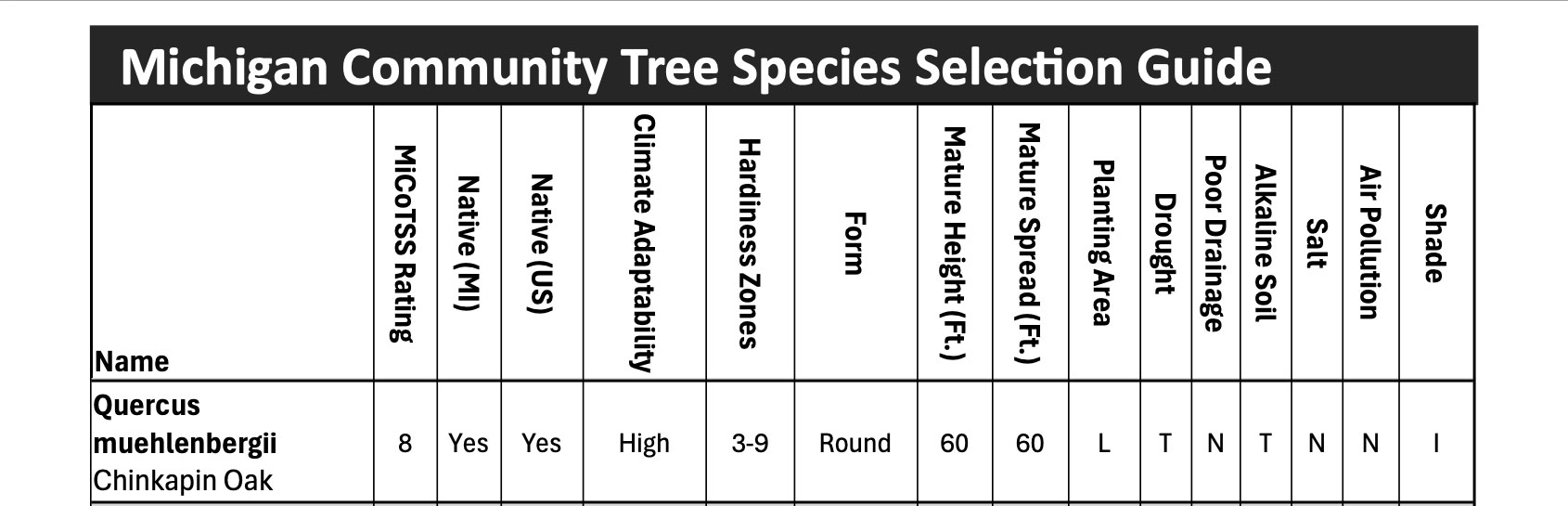
These are fallen leaves from the tree above, and they aren’t around for long because the area below the tree gets mowed. Not so philosophical with this one. I remember when I first visited this tree; aside from being in awe of its size, the leaves were unlike any oak I’d ever seen. They aren’t very common, but still native to the lower portion of Michigan. With the general northward shift of plant zones, Lower Michigan is the northernmost part of this tree’s historical range. Fallen leaves are associated with autumn, reverence, and nutrients.
The Michigan Community Tree Species Selection guide (MiCoTSS) has a pretty strange acronym, but it is packed with useful information about various tree species, their resilience to climate change, and their suitability in urban environments, rating them on a scale of 1 to 10. This species scores an 8/10, high in adaptability for Michigan. However, the IUCN Red List warns that the species’ global range could be reduced, potentially losing 60% of its range by 2050 (Potter and Hargrove 2013).
If you combine these various characteristics: high suitability for Michigan + existing resilience for more than two centuries + potential range reductions, you’d think such a large old tree would have more widespread value, especially as a city attempts to be more sustainable.
Autumn Vernal Pool Basin

This photo is from an impromptu late afternoon autumn walk in the woodland behind us, where a monitored vernal pool is. In fact, this view is of me sitting in it. 🙂 Yeah, it is that dry. While vernal pools are expected to dry out frequently, we had a particularly persistent dry autumn, and in fact, this area of Michigan is still considered in moderate drought (D1). As the sun was setting, the canopy began to glow with color, and as you sat, you noticed the leaves on the ground glowing backlit, which added a bit of balance.
Autumn Forest Bathing

This is simply another view near the spot of the previous photo. I had both for consideration in yearly favorites and couldn’t decide between them, so I figured – heck, I’ll just include both of them! Towering Eastern Cottonwood trees (Populus deltoides) are common here; they love floodplain forests. It was only this particular section that I noticed lacked any strong crossing trunks or lines, which can disrupt the feel.
So that’s my 2025 set. Thank you to the visitors here for your ongoing comments, feedback, and for following my work and various babbles, jibber-jabber, err… notes from the woods. If 2026 brings more photo waypoints, I can’t ask for more than what Baba Dioum expressed 58 years ago on this journey around the circle. Thank you for visiting.
p.s.
Be sure to head on over to T.M. Schultze’s 2025 List of Lists for more great photography and stories.


A fantastic set of images Mark! As usual for your yearly review. Wishing you a great and creative New Year!
An excellent selection of your work. There a lot to like here. It is a process to make collection like this – a moment or two to reflect. Best wishes for 2026!
Thank you Tom. Yeah – a process indeed. Best wishes back atcha!
I guess I’m going to be the odd ball and pick: Autumn Vernal Pool Basin. Primarily because of the colors and perspective. Looks like a good year even though there were fewer images of choose from. I also like how you write about each image, which adds to my enjoyment.
I never really know how much to write, don’t write, if it matters, etc. So I appreciate the kind feedback Monte.
I have to agree with Alex—there’s simply no way I can pick any single one as my favorite. They are all truly stunning.
Your comments that the annual process of writing a favorites posts can “leave one with self-imposed judgment of what a ‘good crop’ is” also struck a note with me. I’ve done these kinds of posts rather inconsistently over the last several years, and I remember feeling “inferior,” almost embarrased, at the time I wrote them because I would only have five images to share vs the 10 or 12 or 15 many others were posting. Then, I realized that I was letting others dictate to myself the value of my own accomplishments. Changing that mindset lifted an unnecessary weight from my shoulders.
I go through the same self-judgement but honestly, this approach of being waypoints on a circle is something I’ve only recently begun shifting my mindset to. I photographed a lot of stuff that just didn’t work out like I thought, but maybe I’ll revisit it another day. Those are points too. I guess picking 10 is largely cultural – so many lists seem to focus on that number. I certainly didn’t have 10 that I exposed AND fully developed from 2025. Learned that years ago to make that internal rule for myself – I only had to finish the photo in the year. 🙂
I’m going to follow Alanander’s example and not choose a favorite. There isn’t one among these ten that I dislike or wouldn’t be proud to have created. Reading and reflecting on Sterling Oak reminded me of times I’ve been in a deep forest, where I felt a sense of reverence at least as strong, if not stronger, than what I feel in a cathedral. In my humble opinion, nothing made by humans can compare to placing hands against the bark of a large tree that has lived for hundreds of years. Interestingly, trees/tree leaves appear in six of the ten photos. And yes, we are broken in so many ways.
No expectations for anyone to pick a favorite and you can dislike all or any you wish. 🙂
I like your comparison of cathedrals – I feel the same way. While I don’t expect everyone to feel that same reverence, I think we are also at the point where ignoring the science behind their contributions to our wellbeing is rather shortsighted and foolish. I hadn’t consciously recognized the tree/leaves presence in the majority – but I suppose that makes sense. They are closeby subjects that don’t run or fly away, ha.
A nice selection of photos, Mark. I’m not going to pick a favorite, they’re all really good! Thanks for showing that photo of the Lake Huron shoreline. It blows my mind just how big those lakes are — it might as well be the ocean, for all I know. Thanks for the many words of wisdom in between the photos as well. I must think about my approach picking my photos, including photos that I published, rather than made in a year, seems more practical for my slow way of working with them. Inspirational, glad you put this together.
Thank you Alex, yeah – the lakes are big, and I suppose if all you can see is a horizon line – it may as well be as big as an ocean.