


Ten years ago, a great disturbance in the force was felt when the 10,000-word Oxford Junior Dictionary eliminated the words acorn, fern, and other nature-related words to make room for words like blog and broadband. The publishers’ rationale at the time was that it was simply part of the typical process of word elimination to reflect the environment in which most children are exposed. In turn, many famous authors signed a letter of protest, as it seemed to symbolize a growing concern about the disconnection from nature, and such word eliminations simply added fuel to the fire.1
The publishers simply countered that the words are included in other dictionaries, just not this one, intended for early learners. When you have more content than space, you have to make some tough decisions, ya know? However, you have to wonder which had greater influence, the perception of the publishers that children are more removed from nature, or the publishers themselves?
While this is now old news and ancient history, the process surrounding how it happened is symbolic of many other decisions today, much more consequential than the shuffling of words. Our brains have only so much bandwidth, and, consciously or not, we tend to ignore, spend less energy on, or filter out less personally relevant inputs. Human evolution is filled with thousands of examples of our brains working to conserve limited energy, efforts to “conquer” variables outside our control, or profit from making life easier.
The cognitive sciences call this psychological distance; for example, reduced exposure to natural and wild environments strongly influences decision-making and its priority in our lives. Perhaps ironically, it is our evolutionary environment and nature that helped us develop this biological encoding. On the savanna, and not being at the top of the food chain, our ability to detect and respond to the most immediate threats, filter out what is irrelevant, directly contributed to our survival. We’ve largely eliminated those threats, except for those caused by our own species, tamed the land, created safe spaces, and allowed ourselves to drift away from these core instincts.
Psychological Distance from Nature
So, what is psychological distance? It is much like you’d expect: the closer you are personally to a particular environment or subject, the more impactful it is on your life and decisions. Something that happens to you, a direct experience, in your own family or neighborhood, is going to take cognitive priority over something on the other side of the world. Similarly, an immediate health issue captures our attention, whereas a future health risk may not. These seem like common-sense expectations and are interestingly defined and studied as four primary dimensions of influence:
- Temporal Distance: related to distance away in time, the past or the future
- Spatial Distance: physical distance between you and something
- Hypothetical Distance: related to probabilities and experienced reality, chance of happening to me
- Informational or Social Distance: your direct experience or education
With these aspects in mind, it isn’t difficult to see how each plays a role in many of the ongoing threats to natural habitats worldwide, past, present, and future. It even plays a role in such trivial things as removing the word “acorn” from a dictionary. If such distances can be bridged, you can see how many well-known environmental writers, philosophers, scientists, and artists have attempted to do just that. For any connection made, it has a direct correlation to how much awareness and caring is out there.
However, connections can be fleeting. There is a theory in psychology that doesn’t exactly roll off the tongue, called construal level theory, that examines how these gaps influence our thinking and whether any bridges built are long-lasting or ephemeral.

For example, when my photography really started getting “serious” (back then defined as switching to slide film! 🙂 ) in the mid-90s, it was heavily influenced by a concern for the welfare of, and a desire to show, the interesting and seemingly foreign life underwater experienced while SCUBA diving. Despite occupying 70% of Earth’s surface, regulating relatively stable planetary temperatures, and directly producing more than half of the oxygen you breathe, the world and life beneath it may as well be another planet to most. My passion was influenced by experience and by closing the psychological distance across all four dimensions. It is simply difficult to care about something you don’t know, so I sought to know it better, not necessarily out of any conscious recognition of these terms about distances and their influences.
When it comes to sharing those experiences in photographs, however, there is a dilemma for anyone who hopes that photographs help people connect. They can, but to a very limited extent. You’ve likely heard the reference to how a photograph wasn’t quite the same as being there. These psychological distance gaps are a part of that. Someone can appreciate the novelty or beauty of an underwater photograph, but experiencing it is on another level. While the psychological distance I closed was highly visceral, showing others photographs of such otherworldly things only goes so far to establish anything lasting.
It’s this construal level theory that seeks to explain how our brains process and solidify various connections. In fact, it is one of the theories that attempt to explain why action on climate change is so damn hard. There is a lot of psychological distance across all of its dimensions to this problem: temporal (“it’s far in the future”), spatial (the risk is in places away from me), hypothetical (the discomfort with the variability and unknowns), and informational/social (lack of knowledge in science or impacting me personally). That’s a lot of distance to bridge!
Bridging gaps in mass is no easy task, though thousands of people are trying. Now, coral reefs are already in peril in a largely disconnected, warming world.2
A Growing Pandemic?
Julia Butterfly Hill, an activist who in 1997 spent 738 days living atop a 55 m (180 ft) California redwood tree in protest against the destruction of the world’s ancient forests, wrote an Earth Day essay in 2021 titled “The Disease of Disconnect” for Atmos Magazine.3 Her essay continues a long tradition of ecologically minded writers seeking to illuminate the widening gap between humans and nature and the reasons for such disparity among individuals. Even in the most rational and objective of discussions, psychological distance gaps can seem like you are trying to communicate with someone across a ravine who speaks in an entirely different language.
If such difficulties are merely one of the many symptoms of this condition and the resulting issues, it certainly resembles a global pandemic.
“When people ask me what the greatest environmental issue is, i have always—from the early days, up in Luna’s branches—replied that the biggest issue is the Disease of Disconnect. Just as we rip a plant or tree’s roots out of the ground, it begins to wither and die; so, too, does our human consciousness. We see ourselves as “separate from” instead of deeply interwoven and interconnected. And what we see happening in our world and to our Earth is the direct result.”
~ Julia Butterfly Hill, Disease of Disconnect
History is filled with similar observations from other ecologically minded sages. People have looked to poignant words and experiences to bridge their own gaps, from William Blake, who wrote about the range of reactions to a tree—from joyful tears to being a thing in the way—to John Muir, who wrote extensively about how much more is connected than we realize, to Aldo Leopold, who saw a world of wounds. However, this is only if someone is motivated to do so; Hill suggests a more passive spread, like a contagion, leaving one wondering whether there is a cure. While ripping roots from the ground is symbolically powerful, the unfortunate fact is that, as a species, we’ve been incredibly innovative, for better or worse, in finding more ways to keep our hands out of the soil. Despite many exasperated pleas of ‘Can you not see what you are doing?!‘, they are often met with a response of proud, if not myopic, willfulness, in the ultimate rebranding of the disease as ‘progress’ and achievement of conquest.
Just as a smoker rationalizes that one more cigarette isn’t going to hurt, civilization emits that one more gigatonne of CO2, or the mother hub trees lost before the local ecosystem collapses, so too is this seemingly slow disease progression relative to our ability to rationalize and spin the costs. Whether you are an environmental writer, activist, photographer, musician, or artist, any attempts to bridge gaps seem to resonate mostly with those already on your side of the expanse, an eco-chamber. The generational knowledge and wisdom in connection held by many indigenous cultures diluted or forcibly torn apart where removing the definition of the word “acorn” for children is likely absurd and unfathomable. We can try to illuminate disconnection, but it does little good if the light doesn’t reach where it is darkest and most needed and simply becomes shouting into a void.
If we face such an existential threat, we may accept that a complete cure may conflict with our self-interest, and that a sustainable bridge across the psychological distance from our environment for growing populations is impractical due to competing interests. We manage symptoms, fight local skirmishes, and bandage wounds until the collective consequences meet an unmovable barrier, perhaps set by physics. Scientists describe our current period as the Anthropocene, a grand experiment, testing whether natural selection favors or disfavors disconnectedness.
Jane’s immunity
Last September, just before her passing, my wife and I were fortunate enough to go see Dr. Jane Goodall speak while she was in Detroit during her 2025 Fall Tour. At 91 years old, she has certainly experienced more trials, frustrations, hardships, and setbacks, as well as moments of pure joy from the connections she has established, than anyone alive today, except for perhaps Sir David Attenborough or Dr. Sylvia Earle. Yet, she famously maintained a hopeful outlook.
There was not a trace of Disease of Disconnect in Jane, as if she were completely immune. There is no question that she tried to share that lifelong immunity worldwide, as if sharing a serum from her own blood. Despite a long and rewarding life filled with efforts to bridge the gap across the ravine, even to make the most fleeting of connections, she also acknowledged that the current challenges are unlike any she has ever known. However, in her projects working with children, she placed her hope in them. Her remarks about some current world leaders, not so much.
If fighting the Disease of Disconnect is anything like battling cancer, maybe any measure of progress will result from tirelessly chipping away at each stage of the disease, making it either manageable or survivable for longer terms, even if a complete cure remains just out of reach. If it is impractical to expect all gaps of psychological distance to be closed, how many are enough? Perhaps that is where the inspiring Goodall Hope lies, despite it being a road of inevitable hardship, sacrifice, and failure. There is substantial debt to repay as the unpaid principal continues to grow.
About the photo
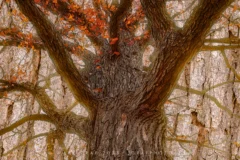
The top photo in this post uses the multiple-exposure technique I began experimenting with for my Fusion Series of photographs a couple of years ago. As with many projects I start, it seems to proceed sporadically when I encounter a situation that works or feel inspired. The tree itself may be quite symbolic of Ms. Hill’s Disease of Disconnect. While it is not a thousand-year-old California Redwood, it is an ancient historical tree for Southeast Michigan, which was extensively logged during the 1800s. Finding old trees that survived that period, as well as the decades of sprawl and development throughout Metro Detroit, is rare. Their survival depends more on the alignment of fortunate circumstances than on any multi-generational commitment to conservation.
The tree, a Chinquapin Oak (Quercus muehlenbergii), a keystone species, is estimated to be at least 260 years old, making it older than this country and a testament to resilience, having survived encroachment, disease, storms, floods, and even war. Unlike most aged human infrastructure, it is quite healthy and thriving in the floodplain it occupies, and is ranked among the 10 largest known in the State. If you are unaware, oaks support more life forms than any other North American tree genus.4
This pandemic of disconnection creates a lot of challenges in these situations. This old tree, not protected by any laws and not threatened or endangered as a species, may also become a casualty of a long history of disconnected decision-making, failing to understand and to place appropriate value on its contributions to biodiversity for policy and people.
The story, unfortunately, is simply one of thousands.
“To the young mind, every thing is individual, stands by itself. By and by, it finds how to join two things, and see in them one nature; then three, then three thousand; and so, tyrannized over by its own unifying instinct, it goes on tying things together, diminishing anomalies, discovering roots running under ground, whereby contrary and remote things cohere, and flower out from one stem.“
~ Ralph Waldo Emerson in The American Scholar
That’s a problem, as we literally rip roots from the soil. No one can make reasonably informed decisions if they do not understand, lack connectivity, or even seek to understand, the true costs of an unrealized inventory and its purpose, when our laws provide only limited guardrails.
One aspect and principle of the project in doing multiple exposures in camera is that they are fused into a single image file– inseparable, like many connections in nature, no matter how much we pull, pry, or turn a blind eye to. Visually, the resulting ethereal yet ancient portrayal of this old tree finally created an aesthetic that felt more fitting of its character than many prior attempts.
The world would be in a much better state if every old tree had someone as dedicated and committed as Julia Hill, if Dr. Goodall’s natural immunity were more widespread, and if we weren’t increasingly disconnected. We can try to honor their commitments by minimizing the spread of such a disease as best we can. Perhaps the hope Jane placed in future generations continues with planting more seeds, as long as one knows what they are called.
Parting Musical moment of Zen
Writer’s afterthoughts: This post was edited a bit for clarity and clunkiness after I hit the PUBLISH button. Regrettably, it seems to happen frequently with me. It takes a while to write, edit, rewrite, edit … I get impatient with finishing it or simply looking at it, then read it in another format, like on my phone, and want to tweak things here and there. Like many photographs, it’s not really done until I leave it alone. 🙂
- Flood, Allison, Oxford Junior Dictionary’s replacement of ‘natural’ words with 21st-century terms sparks outcry, The Guardian, Jan 2015 ↩︎
- Einhorn, Catrin, Heat Has Essentially Wiped Out 2 Key Coral Species on Florida Reefs, New York Times, Oct 2025 ↩︎
- Hill, Julia Butterfly, Disease of Disconnect, Atmos Magazine, April 2021 ↩︎
- Roach, Margaret, Why You Should Plant Oaks, New York Times, March 31, 2021 ↩︎


My answer to your second question is yes: the publishers themselves. I must agree this is a well written post and done much better than I could have. In fact I have waited a few days to respond because I feel it will be an inadequate response. But I have read it more than once and there are nuggets for me to chew on and some things to make me grind my teeth. This country is very disconnected from our natural world and in so many ways feel as though the are not part of it. I enjoy the natural areas around the city but it saddens me to see people out walking or running the trails wearing earbuds and a smartphone around their arm or waist. I even encounter some talking on the phone. They might as well have jogged around the block at home. I will need to revisit this post more than once. Thank you for the effort and time you put into it!!!! And, yes you are spot on!!
Your remarks are appreciated Monte. No expectations on the comments, I suppose if I was reading this I wouldn’t be so sure what to say other than nodding in agreement perhaps (but then I am biased 🙂 ). It was just something that came to mind after reading a few related materials and figured I’d get it out of my head. I wonder if people wearing the devices (headphones and such) are trying to tune out the world themselves as it has become too busy for them. Maybe they don’t realize there are other things to keep one’s mind busy on the trails. I think it takes a “quieting” before one can even start to listen to what nature offers. Best New Year’s Wishes to you.
The aspect of experiencing nature that interests me the most is learning about connections: how living things depend on a network of relationships between habitats, plant life, invertebrates, and vertebrates. At first, it was a matter of learning about butterfly larvae and host plants or orchids and their symbiosis with fungi (mycelia). Being outside is nourishing.
Loved the oak image. Have you read the novel The Overstory by Richard Powers?
The Overstory book was one I started to read but for some reason found it difficult to get into and never finished it. Maybe I didn’t give it enough time.
Great job, Mark, on writing this thorough post. I’m sure you put in a lot of time and effort. It’s certainly beyond my own skills. Even writing a comment to this is daunting. ~smile~
Having grown up in an era when much of today’s terminology didn’t exist and when the majority of my development took place in nature, I’ve long worried about how the societal shift in focus away from the foundational elements of our existence and environment is affecting our children’s development. My grandchildren seem to have a perpetual phone stuck in front of their faces, and their connection to nature and the natural world they inhabit seems inadequate. While in the future they might rally around an environmental cause, I fear it will be more of a mental-social exercise than a hands-on experience. There is a disconnect, and it seems to be growing wider.
I’ve always viewed nature photography primarily as a means of documentation or artistic expression, rather than as a catalyst for connection or change. However, I’ve come to realize that photography can serve as an agent of change over time, illustrating a before-and-after perspective. Unfortunately, this realization often comes too late.
Happy Holidays!
Thanks Earl. It did take a bit of time because I am a VERY slow writer and always seem to think of other ways to say something after I hit the publish button even though it takes me a long time and a lot of drafts to even get to that point. Or some sentence feels awkward to me that for some reason didn’t stand out before. Given the time of your comment, I was likely changing the post as you were commenting – so if anything felt awkward, maybe I fixed it! LOL. To be honest, I am not sure how I feel about photography serving as a change agent over time. There are cases of some powerful photographs for sure, maybe even inspiring some momentary action – but on the global scale of things, I am not so sure. Certainly there have been trillions of nature photographs published in comparison to the point of them becoming a commodity outside of any personal rewards.
I think Julia Hill’s quote “We see ourselves as ‘separate from’ instead of deeply interwoven and interconnected” is so spot on. It definitely seems that, as a society, we don’t consider ourselves part of nature. I cringe when I see people comment online, usually on social media, that humans don’t belong here or that humans don’t deserve nature. I understand the sentiment behind such comments, but they simply reinforce the concept that there is nature and there are humans, and the two do not belong together. That idea couldn’t be further from the truth. But, as you so eloquently write, we have become so disconnected from nature that we can no longer see how intermingled our wellbeing and the wellbeing of nature really are. Until we regain that understanding, things are unlikely to change.
That sentiment of not being part of nature is quite prevalent I think, likely driven by this long period of disconnection. After all, it is bitter cold outside and I am here typing this in a warm house, I don’t need to worry about some predator having me for lunch, I don’t need to seek out water, and can have food delivered right to my door, quite different than the birds and squirrels outside my window. I guess it is kinda like Degrees of Separation from Kevin Bacon, ha! Of course in the US, we are many degrees removed from where our food comes from or what it takes to heat and power our houses to the point of taking it for granted. I am not so sure that is sustainable in the long run, or will be simply be increasingly biased towards those that can afford it. But I also don’t see some grand ideal of us being more connected to more, even if our wellbeing ultimately depends on it because we are largely blind to its influence.
Sadly, I think you’re right. If you ask people to tell you where their food comes from, the answer is most likely going to be the name of the supermarket where they bought it. You can’t get much more disconnected than that. I’m certainly not saying I’m a whole lot better, but I would like to think, perhaps mistakenly, that getting out in nature with my camera on a somewhat regular basis opens my just a little bit to not only nature’s beauty but also its importance to our mutual survival.