


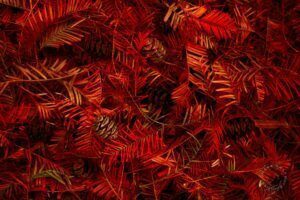
These pine cones are from two dawn redwood trees I have in my yard – where I also have a white pine as well. The unique shape of these cones made for a great pattern study. I actually fumbled around for a while until finally settling on this composition. It was interesting how the single white pine cone changed some of the dynamics. I wanted to position it so it would act somewhat of a barrier to your eyes leaving the frame and bounce them back up again. I used a soft gold diffuser to bounce some warm light into the patterns to enhance the texture.
Dawn Redwood (Metasequoia glyptostroboides)

These trees have an interesting history as well. Though they are related to the more famous genus of Sequoia redwoods, no one seemed to know they existed before the 1940s except in fossils. Then a small forest of these trees (only about 5,000 supposedly) was discovered in China, some Harvard researchers went to collect seed samples, etc – and so they started to be cultivated elsewhere. There is a preserve of these trees now in North Carolina, Crescent Ridge Dawn Redwoods Preserve, that will not open until 2035 to hopefully re-establish a native forest of them. Their site has a lot of interesting tidbits about these trees, including some photos of the fossils. I am not quite sure how they became ornamental landscape trees, but it seems I have a link between my yard, North Carolina, and ancient China.
Update 25 April 2020: Since originally posting this, I have come across a few interesting mentions of Dawn Redwood (Metasequoia glyptostroboides) trees:
- Some men took on an effort to populate Dawn Redwood trees in Petoskey, Michigan
- I learned the remnants of the historic City of Detroit nursery has a stand of Dawn Redwoods there which I want to go see
- Duke University has a Dawn Redwood Garden, planted in 1949
My trees seem to be producing saplings on a regular basis now. I am hoping I can help them all grow to maturity, somewhere in someplace.
Visit my Nature Details Gallery for fine art prints, canvas, and other wall art.


Why don’t I get cones on my dawn? She’s 17 years old and over 80 feet tall
Unfortunately I don’t know – perhaps consult an arborist?
Shirley just posting a note here based on what you found in case anyone else comes searching. Apparently colder climates can impact cone growth which is interesting. Here North of Detroit it gets pretty cold for winter, but we are also in a warmer basin than the rest of the region.
To those with questions about the dawn redwood, feel free to follow the original poster’s link and drop me an email. Michael and Ben, I have the answers to your questions as well.
Mark, thanks again, and we are also sending out a quarterly newsletter on the Preserve now, so if you want to be added, lemme know. We have workshops from time to time, so perhaps you can still make it before you go blind. 🙂
Hello Mark! Very interesting composition. It’s very pleasing to the eye, being that it likes to bounce around the image. Eye candy :).
The gold diffuser worked well for giving the image a nice subtle yellowish tone that works very well in this image. I never heard about these trees before I may take a spin on the net and try to find the site about these trees. Think they could be planted up my way in Ontario? Very nice work! Keep it up!
Ben
Hey, Mark! Excellent image. At first, I found the needles distracting because I was looking for the cone stems. Then I realized that the pine cone and needles provide exceptional contrast. … I have some cones on my desk — wondering what they are — and receive incorrect guesses from folks who do dendrology for a living. Now I see why. Thanks for the answer.
Carl – thanks! Thanks for droppin in from the sticks.
D.A. – you are welcome – I hope to make it down there to see it in 2035! I may not be able to see well by then, but I’ll give it a go.
Mark, thank you so much for mentioning the Preserve. I hope you will visit when we open. You are obviously a true fan of this magnificent tree.
Your pic has wonderful composition; the Pinus strobus cone did the trick.
Hey Mark
Just a quick check in – this is a KILLER photo, bud. I love this.
Cheers
Carl
Thank you Richard, Tammie.
Anita, I am glad you two picked up on the pine needles – they are an intentional and integral part of the composition.
Michael – pine cones are available! 🙂 I just don’t know if that is all you need to start one of these trees.
This is a wonderful image here Mark, and some very interesting information about this particular tree.
Don’t think I know much about this tree other than what you have told me here, … now I am wondering if there are some seed available? 🙂
Michael
What a beautiful composition. I particularly love the way the graceful, curving pine needles embrace the cones and bring it all together. I see that Earl appreciated the contribution of those curves, as well.
beautiful pattern study, wonderful photo!
A very nice arrangement Mark. I have a hard time doing these sorts of still life images myself and can appreciate a well-composed one.
Thanks everyone.
Hi Petra, it might make for a nice wallpaper. I tend to have a preference for simpler onces though – icons might get a little lost in the pattern you think?
Excellent abstract. The cones themselves are beautiful but I find the little curly things just take me on a joy ride through the image. A real winner!
Hi Mark, as a fan of structures and patterns I love this photo of course. I could imagine this becoming a wonderful wallpaper including some relief textures. Did you ever think about this?
what a stunning image! appreciate the natural history too, has been a bit too long since I dropped by– alot of good stuff to catch up on. Hope you’re enjoying the season 🙂
Interesting story and beautiful photo Mark!
I think you accomplished your objective with the placement of the white pine cone and I also find my eye following the gentle curve of many of the pine needles–almost like waves upon the rocks. Humm…something very Zen about it.
It’s already been a good day, I just learned something not only about dawn redwood trees but also about North Carolina. I guess it proves you need to look at the wonder under your feet before becoming too enamored with the distant horizon. Thanks for the interesting information and sharing the wonderful photo!