


Perhaps you had a surprise today waiting for you in your email inbox? If you received an email from Facebook stating content you posted was removed for copyright infringement, perhaps even sent to “Facebook Jail” as a result, this post offers some education on why you would receive such a notice.
Hello,
We removed or disabled access to the following post on Facebook because we received a notice from a third party that the content infringes on their copyright(s):
Example Facebook email
… We strongly encourage you to review what you have posted to Facebook to make sure that you have not posted anything infringing, as it is our policy to terminate the accounts of repeat infringers when appropriate.
Why did I get this notice?
The short version is – you posted something that didn’t belong to you or didn’t have permission to use. A violation of copyright.
The TL;DR version is tied up in something called the DMCA (Digital Millennium Copyright Act), and Facebook, by law, is required to follow it.
DMCA Safe Harbor
With wide-ranging ties in everything from lawsuits about Prince’s song “Let’s Go Crazy” to lawsuits that ultimately led to the fall of Napster for illegal distribution of music, the DMCA created something called “safe harbor.” While some provisions of the DMCA attempt to protect the property of all sorts of artists when it comes to the internet, it also (perhaps ironically) creates liability protection for the user-content-oriented services that distribute content on their servers.
BUT WAIT, THERE’S MORE!
To be included in these safe harbor liability protections, social media companies like YouTube, Facebook, Twitter, Instagram, Pinterest, etc must follow some very specific procedures to help artists protect their property. If they don’t, they open themselves to potential liability and loss of safe harbor protections.
So basically the content you posted was found by an artist (or their representative) and reported to Facebook. They MUST act upon it to keep their safe harbor protection in place. Many might call it a “we aren’t responsible for what our users post” excuse. As a user, you agreed to one of those long Terms of Service agreements (that you read right?) which includes language about agreeing to obey copyright laws and the consequences of not doing so.
For most platforms, the mitigation has not scaled in proportion to the size of the problem.
Some Copyright Myths and Excuses
1. I didn’t know it was copyrighted!
As an artist involved in DMCA takedown notices, this is a common email I receive. While copyright law can be complicated, the courts (and many legal cases) have taken the position that ignorance is not a valid excuse. That’s because you don’t really need to know all the little details.
All you need to know is this…generally speaking – all creative content is protected under copyright law. See how easy that is? If you want to be on the safest side, that is the approach to take. Distributing it without permission can land you in some trouble.

2. I didn’t know it was yours!
Another excuse is “I didn’t know it was yours.” This could be. Although I do watermark my work specifically for this reason, some people have chosen to remove it or crop it out. Many photographers do not watermark their work. It isn’t a requirement. However, the intentional removal of a watermark is evidence of willful infringement – something that could land you in much deeper legal trouble than Facebook jail. Another thing, if you have someone working on your website and they tell you “they found an image on Google (or Pinterest, or Instagram, or anywhere else)” and told you it was “free” — you should fire them, immediately.
The reasoning to avoid this problem is very simple – if you don’t know – don’t share. Easy peasy.
3. I am not making money from it
This is another invalid but commonly used “justification.” It does not matter if you are making money or not. You are distributing the content and the artist has the sole right to control the distribution of the content. While that may seem like some crazy idea in the age of the internet, many artists find their work in some pretty bad places.
In turn, people posting content they don’t own became enablers to others who may be using the content nefariously, proliferating the distribution regardless of the reason. It is damaging to the value of the work and damaging to the artist trying to make a living from legitimate licensing. Would you unlock a door for a thief?
Oh, and here’s a good one often seen on the internet – a disclaimer about “No infringement intended.” No attorney in their right mind would back you up with that.
4. I gave you a credit line
Please don’t assume putting their “@” Instagram tag as a credit protects you in some way. Most photographers know that someone using the “exposure” reason is quite humorous and insulting. Some are OK with it – but don’t assume unless you check first.
Next time you get your mobile phone bill, tell them you’ll make a rad Instagram post about them instead of paying it, and see how it goes.
Advertising and global reach
Another use that is common on Facebook is to use images to promote other content.
Attempting to gain followers = Advertising
Trying to get more views on your channel = Advertising
Distribution to your friends + having business links = Advertising
And much more.
This is rampant on Facebook, Instagram, and everywhere. It is a blatant copyright infringement and is often subject to liability damages beyond just taking a post down.
Facebook pay-to-play
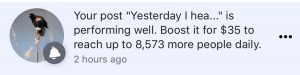
Facebook intentionally restricts the reach of any particular page so they can sell you on boosting (ie. the pay-to-play business model). A post on a page might typically only reach 10% of its total followers. Posts with pictures are known to reach more people.
Some Instagram pages try to sell you on being a featured artist to distribute your work to their massive follower list – again, trying to sell the exposure. It’s one of the biggest self-serving scams on social media.
Facebook Picture-Sharing Pages
In my opinion, these can be the worst offenders.
These are Facebook & Instagram Pages (even personal pages) that just post thousands of pictures from all over the world. You may see them named something like “Nature’s Beauty”, “Amazing things”, “Housekeeping”, “Awesome Pics”, etc in every language on the planet. Science pages, travel pages, geology pages, anything you can think of. Some may give credit, but that does not necessarily get them off the hook. Some artists may be OK with a simple credit, some may not.
You see a beautiful picture and want all your friends to see it, and it is as simple as hitting that share button. Social media relies on this simplicity. How many times have you thought about who created it?
There is simply just a HUGE difference between sharing off an original content creator’s Page VS. sharing it from someone who “repurposed” it. It is a well-known approach and abuse with viral content. There is even a term for it – manufactured virality.
But copying, taking a screenshot, and reposting as native material on your own “influencer” page or other is illegal and wrong. The best way to show appreciation is to follow the creator/photographer’s page, and share the posts using the share buttons there.
Why is it a violation to share?
There are two very basic reasons:
- By using Facebook, you agree not to violate copyright laws (in their TOS) – which includes any distribution of content without explicit permission. Only the originating artist has those rights.
- In the Facebook TOS, you authorize Facebook to distribute the content you post and claim you have the rights to do so. You can’t authorize this to something you don’t own. (This is Facebook’s basic “it’s not our fault what our users do” clause to avoid being sued)
Tips to not be part of the problem
If you want to help combat the proliferation of such pages, all it takes is a few simple questions to ask yourself before hitting that share button:
- Who is the artist who made this image? If unknown – DON’T SHARE
- Is it clear the image is shared with permission? No? – DON”T SHARE
- Is the image shared from the original artists’ page? – Yes? SHARE THAT POST. (Do NOT save the image and repost)
How to get out of Facebook Jail?
UPDATE 19 Feb 2022: Facebook (Meta) now has an information page on their content strikes which makes my guesses originally published partially true, but now corrected by official policy. The policy is quite lenient in my opinion. So if you have your account shut down, it is a clear indication you are a repeat offender. But Facebook can have curious enforcement at times, so it is rolling the dice by engaging in such behavior.
If you get a temporary account restriction, the best advice I can think of is to wait it out. Take it as a learning experience. You could try to appeal to the person making the report. If it has any hint of a marketing/promotional/global reach or commercial use, offer to settle with a licensing agreement.
Avoiding jail – don’t violate copyright laws
It is best not to do something that gets you there. This is not censorship as much as I see people mention that. It is not “heavy-handed” Facebook moderation. It is copyright law.

The real loss is to original content creators
There are trillions of pictures shared and posted every year. It is anyone’s guess exactly how much is posted in violation of copyright. It’s a lot. Facebook wouldn’t have an entire staff of people processing intellectual property complaints if there wasn’t.
Creative content that used to license for hundreds/thousands for advertising and other uses may only license for a small fraction of that now. However, legitimate licensing still takes place, photographers are still getting paid for their hard work just like musicians are still getting paid for their hard work.
Sadly, theft still takes place in music, films, software, streamed content, and photography. Don’t be a contributor to it.
Is art on the internet doomed?
If you respect the work of artists, please don’t take part in the illegal distribution and theft of their work. Help educate your friends. Use the hashtag #dontknowdontshare. If you see something from these pages, SAY SOMETHING. Hopefully, someday this very outdated law will change to favor more proactive enforcement.
Maybe helps to put a little bit of that genie back in.


Good post, Mark! I’m curious, how much time would you say you spend in a year pursuing copyright issues with your own images?
Lol! Enough to irritate me, how’s that for an answer? 🙂
All fantastic info. As I am sure you know there are also services that will search for you images on the internet and show you where they are found
Yes, they certainly help, but they do miss a lot.