


Sometimes I wish I had a more systematic way of mining my archives. The logical assumption would be to simply go through month by month looking for photos that I haven’t developed yet or forgotten about. But the reality is I usually do it much more serendipitously, depending on my mood and the work required. I suppose this does have advantages. It makes discoveries much more random and surprising and doesn’t give me a “to-do” list to keep an eye on. As with the last post, I again landed in 2008 and decided to work on something I haven’t touched in a while – something from my Stonescapes series of images.
Rocks and minerals mining
Of course, quite different than photo archive mining – but one could draw some parallels! When I first started on this series of images, I was pretty new to the world of rocks, minerals, mining, claims, naming rights, the whole little universe that operates around this passion so many people have. And if you pardon the pun, it is as deep as you want to dig. And to be honest, I am still quite the amateur rockhound, even more than a decade later.
But early on I did note some prospectors had much better quality raw material than others (at least for my very specific need I was looking for). And many of these specially named “rocks” came from very specific mines, many in the Western US states, some shrouded in secrecy to keep looters away. For example, the Hell’s Canyon Petrified Wood I’ve written about previously comes from a very specific place that is now underwater. Royal Sahara Jasper is from a specific site in the Sahara desert. Similarly, so did this piece of Amethyst Sage Agate.
Amethyst Sage Agate – an agate with “grape jelly”
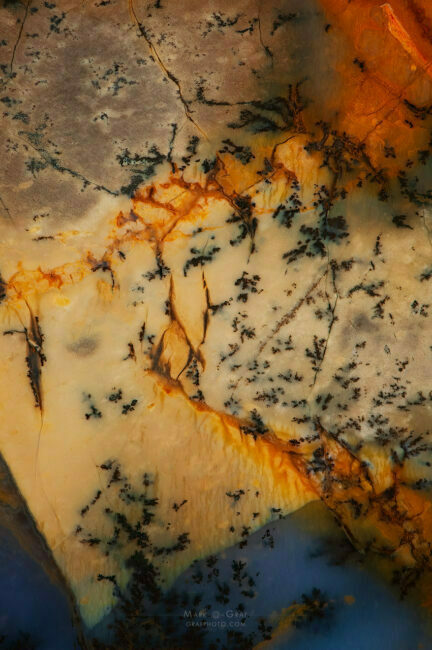
This special type of agate comes from a mine in the Northwestern quadrant of Nevada, near the southern range of the Bilk Creek Mountains. It became notable because of the translucent purple features (eg. “grape jelly) that made it unique from other agates. The manganese dendrites (the black, tree-like features) are a glimpse back in time when this mineral seeped into these layers and developed its characteristic branches. The top featured image is also a particularly nice piece as it has sparkling crystal pockets (eg. vugs) descending from the top left of the photograph.
What is a dendrite?
Dendrites are an often sought-after feature in many rock specimens because they remind people of little trees. A constant reminder of patterns and threads that persist in nature. Not surprisingly, that is exactly where the word comes from, the Greek word dendron, which means “tree.” Many elements in nature grow in dendritic patterns according to how their structure is formed on a crystal level. A snowflake is a classic example, along with frost forming on a windshield. Some minerals do the same thing, especially when the liquid carrying them dries up.
In this second piece, you can see many dendrites that formed along the cracks where water probably once seeped in. It’s almost as if these elements were creating their own type of geological graffiti and had a story to tell.
Looking Back in Time
Whether photo mining or rock mining, I suppose both are opportunities to revisit past timelines of various scales. Each carrying their own notebooks of stories waiting for someone, someday to stumble upon them and read them.


I’ve always loved these Stonescapes of yours! It’s like looking at what we can see in clouds….only in color and way better!
The only thing I wish I could do on these is to try to get a more dimensional feel in them. Of course, they are already flat surfaces, so perhaps hard to do. Thanks Howard.
I remember a period when you use to do these rock and mineral photos fairly regularly and I was always intrigued and delighted by their beauty. I think I even tried my hand at it once after being inspired by you but I found my results to be lacking and therefore saved nothing. Haha!
They can be difficult to control glare and reflections – and some samples aren’t cut cleanly. I still have a pile I need to sort through, but lately it seems like a chore to set it all up again.
Thank you for the lesson on these jewels. I did snicker at you pun “as deep as you want to dig.” It looks like the stone is very smooth, is it sanded? I know so little about rocks except the beauty some offer. Digging in the archives is like time traveling in that i can reflect back to that experience. I like that type of traveling. And, I hope you keep digging in the archives.
It’s a cut slab piece – but I am not sure if it was sanded. It may have been. I’ve never cut through rock so I don’t know how the surface ends up. 🙂
Well said, Mark. I too like to find those little gems serendipitously rather than tying myself to a to-do list only to feel disappointed that I couldn’t stick to it.