


Today, I came across a quote from Rachel Carson that I liked about the ocean. It also encouraged me to think about all the fortunate interactions with the sea I’ve had over the years, especially the underwater ones. Indeed, one of the most memorable was interacting with the sea lions near Santiago (James) Island in the Galapagos archipelago.
“The winds, the sea, and the moving tides are what they are. If there is wonder and beauty and majesty in them, science will discover these qualities. If they are not there, science cannot create them. If there is poetry in my book about the sea, it is not because I deliberately put it there, but because no one could write truthfully about the sea and leave out the poetry.”
Rachel Carson
How fortunate my wife and I were to have toured and dove the Galapagos Islands in 2001. It was the trip of a lifetime that may never be repeated, and highlights of it remain fresh in my typically poor memory. This image came to mind when reading Carson’s quote about the poetry of the sea because of the dynamic aspects of the sea lions at play (with us!) underneath the crashing surf at the surface. It is a beautiful memory of feeling connected to wildlife and the ocean vs. the exploitative nature humans are understandably associated with.
After that trip, I wrote a 14-page HTML-formatted trip report that I never transitioned to WordPress. I put it on my to-do list and never got to the “do” part. It would be a lot of work because all the photographs I included were small at only 350 px wide, with some I would have to hunt for or rescan. It was 2001, after all. All from film scans. But I still have the text of those pages saved locally, so I thought I would republish the visit to Cousin’s Rock in a post here (edited for grammar and clarity).
Cousin’s Rock (log from 2001 Galapagos Trip Report)
Departure from Wolf involved another overnight journey back to the central archipelago—the boat anchored at Cousin’s Rock, just off Santiago (James) Island. Here, we are expected to see Galápagos Seahorses as well as being able to dive with the resident sea lion colony. The dive here involved descending to a sandy bottom at around 80 feet and swimming along a small ridge into the water, an extension of this small islet.
The entire swim was against a reasonably strong current (2-3 knots), and being at 80 feet, you consumed your air rather quickly. We did see a few hammerheads and stingrays along the way, but by the time we got to the area of corals to look for seahorses, it was time to start making our way to shallower waters. This was the first location in Galápagos where we saw corals. The dive ended with sea lions greeting us as we ascended into shallower waters. However, we didn’t see a single sea horse. It turns out the divemaster (naturalist) marked the locations; however, few people had the air left to go and see them. In our opinion, it was either a poorly planned dive or the result of an unexpected current at that depth.
Dive Log Data: Cousin’s Rock #1; 78 ft, 40 min, 73 deg F, 7:52 am
We headed straight towards the sea lion colony for the second dive at Cousin’s rather than wasting air in the current on the bottom. The dive with the sea lions at Cousins was our last dive of the trip and possibly one of the most memorable experiences of our lives. Similar to their curiosity on land, they became very playful when underwater. Here, they could swim circles around, blow bubbles at, and generally make fun of these clumsy, land-based beings in funny outfits. The experience was both heartwarming and humbling.
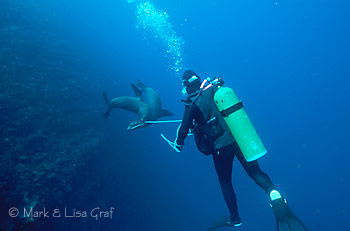
They even went as far as to play tug-of-war with Lisa as she released a rope out under the water. The others certainly couldn’t let just one of them have all the fun, and soon, 2 or 3 more joined in the fun underwater. The dive seemed to last forever as we tried to squeeze every last breath out of our tanks. Photographing them was challenging due to their speed, and they rarely kept in place for very long, constantly moving in and out of the pounding surf. These shots were made with a Nikon F100, Fuji Provia F 400 film, and 20mm lens in an Aquatica housing. Still, I think a 24mm SLR lens or a 20 mm on a Nikonos would be the ideal setup, as you didn’t always have the opportunity to get as close to filling out the frame of a 20mm SLR or 15mm Nikonos lens.
Dive Log Data: Cousin’s Rock #2; 34 ft, 65 min, 73 deg F, 10:06 am
About the Galápagos Sea Lion (Zalophus wollebaeki)
Little did I know during the 2001 visit that Galapagos Sea Lions were experiencing a suspected outbreak of canine distemper (yes, canine!), possibly transmitted through interactions/conflicts with island dogs. Per the IUCN Red List, where this species is listed as endangered, 569 dogs died or were euthanized that year – but they indicate the identity of the virus was never confirmed.
They were once classified as a subspecies of the California Sea Lion, but genetic data separated them into their unique species. They are well-known for their interactive nature and fondness of play. They are threatened by alien species/diseases, ocean garbage, and climate change.


Wow. Sounds like it was truly an amazing trip. I’ve never been a diver but if one is this sounds like an amazing place to go under!
good memories for sure!
I did not know sea lions would play a tug of war. Shows you again what I don’t know. ? I love that you still have wonderful memories of those one hour and 25 minute dives. And, as a photographer a few images to add to the memory. I was never drawn to diving although I watched almost ever show of Sea Hunt. I agree you and your wife were fortunate to have toured and dove the Galápagos Islands and you consider it a trip of a lifetime!!! I’m a bit envious!! It does sadden me to know so many species, including humans, are being threatened by humans. Thanks for sharing!!!
Until that very day – neither did we! We were quite confused when one of the guides handed us a rope. 🙂 But we soon found out. Thanks Monte for the visit.