


Mycologist Paul Stamets often refers to the mycorrhizal network within the Earth’s soil as “nature’s internet.” Through these mycelial pathways, author/scientist Dr. Suzanne Simard explains how trees communicate with each other. Director James Cameron portrays indigenous tribes establishing physical communication links with this network in the Avatar series of films. And most recently, Craig Mazin and Neil Druckmann show us a world where the mycelial network is taking back the planet in HBO”s new series Last of Us.
These networks serve as inspiration behind this latest series of images I made of Eastern Cottonwood trees I observed glowing against a clear blue sky, lit by the late-morning sun. Taking advantage of the bare branches during winter reveals a network of pathways, though a smaller representation of the much larger network that exists hidden underground. The complex of twists and turns in the canopy became symbolic of a basic tenet of life, seek the light.
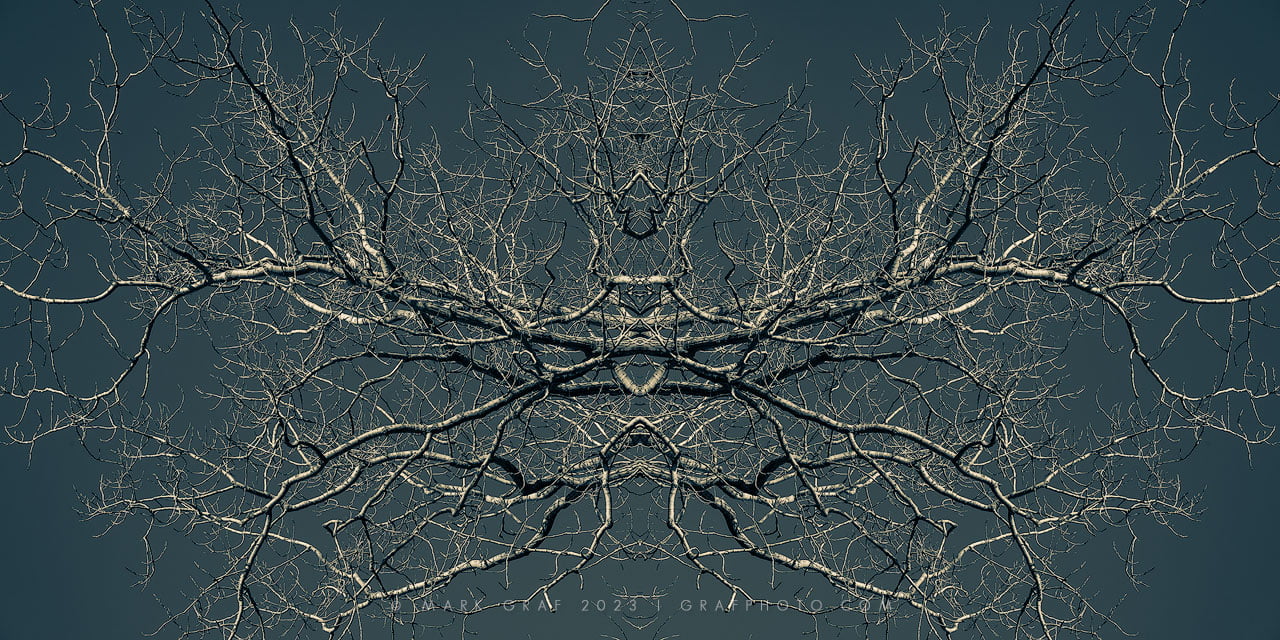
Seeking the light seems simple enough, yet as these structures show, it is not always a straight path or a guaranteed success. There is competition, winners, and losers. Each of these branches will soon begin to bud and erupt with leaves. Evapotranspiration will create a pressure gradient within the tree that begins to pull water and nutrients up from the roots. A new season of cell growth begins or slows, depending on the external threats. Maybe the stresses of the passing season will leave scars. The local drought may force a realization there just aren’t enough resources to feed the survival of so many branches, or ultimately the organism itself. Tree rings will later tell us stories that some years were much tougher than others.
It isn’t so unusual for us to see so many metaphors in trees. Even though my recent inspirations may have come from my love for science fiction, symbols like the Tree of Life have been used for millennia in cultures around the world. Connections between the earth and sky. The ways in which this symbolism has propagated through cultures are perhaps just as complex as the branches portrayed here.
Ultimately the photographs provided me with a lot to think about, haunting in some ways – encouraging in others. I am not sure if that is due to also thinking about the stories that inspired them, or the visual nature of where I ended up with the images. Further reflection (no pun intended) is required.


These images are beautiful in their complexity, while at the same time there’s something unworldly about them. That’s before you even consider the mycorrhizal network or mycelial pathways. Very creative!
Interestingly, your Gravatar Image is two halves (left vs. right). Hmm… ?
These images are beautiful in their complexity, while at the same time there’s something unworldly about them. That’s before you even consider the mycorrhizal network or mycelial pathways. Very creative!
Interestingly, your Gravatar Image is two halves (left vs. right). Hmm… ?
Thanks! I thought they looked a little alien, but I wasn’t sure if it was just me with a SciFi brain.
I’ve had a lot of things on my mind lately where the positive/negative image fits. 🙂
The things we barely understand about nature and it’s pathways are staggering. I love the metaphors the tree makes.
Then when you try to think about how little we know about the universe :headexplodes:
The Brazilian poet Cecilia Meireles once wrote in one of her poems “ all things look for the light, even when they don’t know that they look for it”. Interesting treatment of the branding pattern, which rendered symmetry to something intrinsically asymmetrical.
It became intentional and necessary once I photographed these segments recognizing the asymmetrical aspects just didn’t function well alone, even though they were nicely lit. I do like that quote from Ms. Meireles.
Beautiful set, Mark. As soon as I saw mycologist my mind went to “The Last of Us“ ?
When the government needs to call one in, it is time to worry. 🙂