


Continuing with a tradition that began in 2007, I am once again finalizing some of my favorite images from the past year. I guess you could call this Volume 18. Wow, eighteen years of this stuff.1 Nonetheless, It is a process that forces me to consider which particular photos stood out to me personally or have some more profound attachment, perhaps mainly behind the scenes.
Since I do arbitrarily limit the selection to just ten, undoubtedly, I fill a Lightroom collection with more than ten. Then I start contrasting, comparing, and thinking about “why this one, and not that one?” This year took me a bit longer than expected, and NOT because there was much to choose from, just the opposite. 🙂 As a matter of fact, I swapped them in and out while writing this post. I always grimace about wanting to do more, but I will not do that anymore. I will reflect on what I have done and that’s that.
Eight photos were exposed in 2024. Two were exposed in prior years but mastered in 2024 (to carry over a term I referred to in my Twenty-Twenty-Three list from music production). These would also resemble what the USCO (United States Copyright Office) considers a “publish date.” As with previous years, I found myself sticking relatively close to home, and one image here is from 3 meters (10 ft) off our back deck.
Simply put, nature around us is disappearing faster now than at any other point in human history. The first-ever Global Tree Assessment was released in 2024, labeling at least 30% of the 58,427 species studied as threatened with extinction. Untouched parcels are being gobbled up and decimated under three simple words: Land for Sale.
Unfortunately, our legal framework does not assign any significant value to the loss of mature trees, wildlife habitat, or keystone species. So, if permits and approvals are secured, a developer doesn’t pay for any of these losses; the surrounding community does, the surrounding biodiversity does. Replanting efforts, as important as they are, cannot replace the immediate biodiversity loss. Unfortunately, this means the only way to protect something truly is to own it.
This makes efforts like the Homegrown National Park movement more critical to reestablish habitat on our own property. We should make a payment on the ecological debt we’ve all incurred. We should also support local land conservancies (like Six Rivers Land Conservancy, Michigan Nature Association) that prioritize protecting land and habitat by owning them. </soapbox>
Bottom line, I could probably spend the rest of my life trying to explore all the little remaining habitats near where I live, visit the big trees while there is still a chance, and gaze into the little life-filled ponds before they are drained and filled. I am typically limited more by my abilities to see than by the available subject matter. These annual posts tend to be a bit longer, but I hope you will enjoy some of the insight behind the photographs.
Red-winged Blackbird on cattail

This is an older exposure that I happened to stumble upon—something that happens quite a lot—and ultimately ends up being a distraction to what I was initially working on. I color-graded the original exposure, giving the photo a unique feel I really liked, perhaps to a surprising degree. So, I guess the side-tracked activity ended up being worthwhile. Sometimes, you just have to go with the inspiration as it happens. As I “mastered” this last winter, subconsciously, I was probably yearning to hear the call of red-winged blackbirds, often considered the sound of spring arriving around here.
Flow #6 Water Abstract

With 2024 filled with plenty of frustrations in the U.S. political arena and actions from my own local government simultaneously advocating for preservation while authorizing mass destruction, I increasingly thought about a Taoist concept brought to popular culture by the late Bruce Lee: Be Like Water. Its persistence in movement and adaptability teach lessons about resilience, when to crash, when to flow, and when to erode. Humans are mostly water, after all. We won’t live long without it. So within this very basic but fundamental element of our existence are lessons about navigating the turbulent times we live in.
Silver Lake Dunes Enduring Tree

Last April brought me back to Silver Lake Dunes on the shore of Lake Michigan, primarily to be there for the solar eclipse. Unfortunately, it wouldn’t be anywhere near totality at this location, so it barely got dark. But I felt an obligation since I hyped up the Year of the Wood Dragon after my visit here for the 2017 eclipse. I had to return to see if my prophecy came true! (spoiler alert – they didn’t swallow the sun) One thing happened since 2017, I became a certified drone pilot, which meant an opportunity to explore the dunes uniquely compared to all prior visits. Another thing occurred since 2017 – my cardio endurance vastly declined! These dunes are no stroll in the park.
There is one significant dune hill to climb to the first overlook. I did this in the dark to be at the top before civil twilight. When I ultimately did (with my heart rate up a bit), I was treated to this view of windswept patterns I’d never seen before. My only guess was that it combined the persistent wind here and significant rainfall. And largely alone in this barren yet rhythmic landscape was a tree just starting to bud out for spring. While I spent a long time exploring the patterns in this dune valley, this image with the tree seemed to communicate more for the sense of scale and as a testament to survival in an otherwise very unforgiving place.
Side note: blowing sand and drone prop motors don’t mix well.
Alien Landscape

I would usually hesitate to include multiple images from any one particular trip in my yearly favourites, but these are two that I just kept coming back to. In playing with color grading on this photo, I came up with a tonal combination that I thought was unique and interesting. It also emphasized the alien nature of this landscape and showed a bit of the light/dark patterns seen on this particular day. These photographs were made in the early morning on the day of the eclipse and edged out any photographs I made during the eclipse. Go figure! I just loved how the sand patterns really popped in this rendering. It is a bit difficult to portray in a still image, but the blowing sands are evident here flowing across the landscape – sandblasting anything in their path, including the guy with a camera.
Michigan Aurora Borealis and stars

We had several significant aurora events in 2024 in Michigan (and across the Northern Hemisphere), I photographed two of them. With the combination of our sun reaching its solar maximum in conjunction with camera technology in phones having evolved significantly since the last solar maximum 11 years ago, the internet was ripe with aurora photos. Understandably, it is something that people at these latitudes don’t get to experience that often, if ever. That led to significant crowds at many of the nearby “dark sky” viewing spots — filled with people looking up through their phones. 😀 Not my cup of tea as they say. I found this little spot down the side of an embankment where a lot of people congregated on the road. But I was largely out of sight and had the spot to myself. I particularly liked how the Seven Sisters star cluster appears in this (about halfway up the frame towards the right side).
In response to many questions about how it looks to the naked eye, I previously wrote this: “If you remember from biology classes, light information is received by rods and cones in our eyes. Rods help us see at night, Cones more during the day. Rods aren’t sensitive to much color information. Camera sensors do not have these biological limitations and improve every year. So, just like a microscope or telescope can help us see closer than we can with the naked eye, modern digital camera sensors can also help us see more color detail at night. Looking through your phone (or real camera) is like looking up at the universe through a “microscope.”
Plumbrook Nature Preserve at Dawn

This is a 90-acre nature preserve close to where I live. In suburban Detroit, it is largely unheard of to have this size of property that is entirely undeveloped except for a small parking lot. Even that disturbance is a bit strange, given there is no other access, but I expect it was a condition of whatever grants were involved for its initial purchase. No human-created trails are here, and the perimeter is quite thick with brush and various wet crossings. Access is difficult but not impossible. In some respects, that is a good thing! In 2024, the city proposed a millage that would, among other things, fund the creation of a “low impact” unpaved trail and overlooks on the perimeter. Admittedly, I was pretty conflicted on how to vote on this.
It passed by a very slim margin. Many believe it was intended as a preserve, which means keeping your hands off this land. I appreciate that position. But if the city is faithful to its word and keeps it low-impact, then maybe others can enjoy this unique parcel without jumping creeks or trekking through brambles. Many other land conservancies create low-impact trails on their properties, so it is possible. It may be ok if the city follows those established practices. But this view may be one of the last in its completely untouched state. I would usually be tempted to crop the little bit of me standing in the parking lot out, but I ended up liking the bit of a self-portrait and sense of scale.
Plum Brook Forest Canopy

This photograph results from experimenting with how green plays such an influential role in our color perception. Our eyes are very sensitive to green, so we are most likely to see green in the sky from an aurora. However, combined with many other hues, green can also have an overpowering effect on a photograph. So, this photo is color-graded to desaturate the greens to become more in balance with the other colors around them. Color is more balanced with form and texture, and I liked the overall combined effect.
Old White Oak

This is a very old white oak. I never measured it, unfortunately, but I remembered being captivated by a large, weathered scar it had on its trunk — perhaps from a lightning strike. It seemed to say this tree has been through a lot. Not unlike the many photographs we see of elderly hands or faces. The center crack does resemble a bolt of lightning. It came to represent the seemingly quick way old trees are struck down when they become objects in the way of some other objective. As I was working on this image, I wondered what if such old trees were given some right to exist that overruled the vote of any politician or landowner. After all, it may have existed before there were deeds to lands, a city, a country, or even a piece of paper designating property rights derived from felled trees. The very idea that such a keystone species is viewed as disposable or replaceable is just absurd.
Hogarth’s Paper Birch

This is a segment of peeling bark from our paper birch in our backyard. What I found intriguing was the line between the tree trunk (left) and the underside of the peeling bark (right). It had this graceful bit of curve to it. It was an interesting contrast to all the straight lines in the bark itself. But then I wondered … “ok, WHY is it pleasing?” Then I thought, “well, isn’t that weird that I am thinking about a pleasing line on a tree?” If the commentary on the aurora gives you a hint — I am naturally curious about visual psychology and why we see things the way we do. Sometimes, there is a physiological explanation – other times, it may be a bit nebulous.
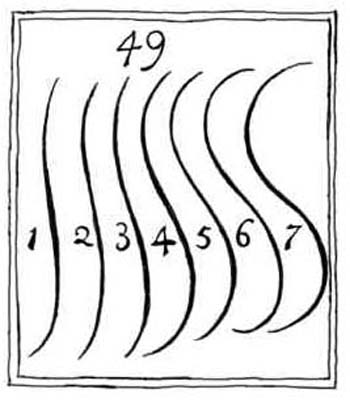
One explanation comes from a diagram I saw in a visual design book. That diagram was from a gent named William Hogarth (1697-1764), an 18th-century English painter and writer who wrote about serpentine lines and our reaction to them.2 He presented a scale where Line 4 was considered an optimal “line of beauty” or “line of grace.” He interestingly suggested the lines in the scale “as they straighten, becoming mean and poor” and in the other direction “by their bulging too much in their curvature becoming gross and clumsy.” I suppose this photograph of the tree is closest to a meanie Line 2. 😀
In fairness, Hogarth didn’t assign such distinct absolutes, only suggesting that objects are “less graceful” as they diverge from the optimally balanced one but are not entirely void of grace. S-curves are a common sought-after element in photography composition, but rarely do you see some of the art history behind why or suggest that maybe the curve is a bit “too much” – haha.
With that, I titled the image with a nod to this 18th-century painter. Alternatively, “Slightly Mean Birch” also has a ring to it.
Artificial Life #1 (working title)

This photograph results from me trying to get a concept out of my head that I admit is not fully understood or flushed out. So, I really haven’t written anything about it until now; I just started playing around with the idea visually last Spring in my yard. This contrast between nature and machines isn’t an original theme, just my own take on it. With 2024 being an explosion of a lot of AI-generated crap, worries and/or optimism about the potentials of AI and quantum computing, demand for energy for data centers, and our prevalent detachment from basic connections to nature, it’s a lot to think about where this is all going.
“Brain Rot” became the Oxford University word of the year for 2024.3 They mention its first use by none other than Henry David Thoreau in his famous work of “Walden.” In an NPR interview, one Thoreau expert remarks on what he used the term for in his time:
… brain rot describes what happens to our minds and spirits when we supress or innate instincts for curiosity and wonder, and instead resign ourselves to the unreflective habits we observe all around us — habits of fitting in, getting by, chasing profits, chatting about the latest news. Thoreau really values direct experience over our habits of consuming other people’s ideas at second hand. He wants us to go outside to feel and think something for ourselves, he wants us to get to know the places where we actually live.”
— Christin Ellis, University of Mississippi to NPR
Oxford University put out this definition:
(n.) Supposed deterioration of a person’s mental or intellectual state, especially viewed as a result of overconsumption of material (now particularly online content) considered to be trivial or unchallenging. Also: something characterized as likely to lead to such deterioration.
I find it particularly interesting that the term was supposedly popularized on TikTok; the irony should be obvious. In addition to our decreased attention spans and instincts for wonder, it never ceases to amaze me the particular disconnection and general ignorance about nature in general. It may be skewed in that my observations come from observing local community discussions in a suburban area, but the things people obsess over and react to are absolutely mind-boggling. (note to self: stop that! not healthy!) STEM teachers have their hands full and could probably never be paid enough.
So, it is somewhat coincidental that this photograph and the year’s term started to align. I was certainly integrating elements of decay represented by the hole in the leaf, and I filled it by placing an old hard drive controller underneath the leaf. (NO, I didn’t use AI) I then took some of the PCB elements and connected them to the leaf to create a bit of a feedback loop. If the natural world decays, is this what we expect to replace it with — our technology? Can the movements of nature-based solutions and AI/quantum computing coexist?
I do not think I am immune to brain rot. It’s probably affected me in some ways I’ve yet to discover. But at least I still hang on to some instincts to wonder, explore, and ask questions. With that …
Thank you to all those who visited these Notes over the past year. Be wary of the rot setting in, and get out and explore nature near you. Visit an old tree to say thank you. Look for those lines that are less mean, gross, or clumsy. And don’t forget to ask on occasion, what would water do?
- Yearly Favorites since 2007 archive ↩︎
- William Hogarth “Analysis of Beauty“, 1753 ↩︎
- Thoreau warned of “Brain rot” in 1854, NPR, accessed 31Dec2024 ↩︎


I’m so impressed (as I always am) with the amount of thought and work you put into this, Mark. I have to start with the R-W blackbird, because they’re such characters. Joe glanced at your photo said, “He’s in full outrage mode!” Fantastic photo, I’m all for color-grading, and yes, that song, that full-bodied expression of Spring!! I like the water abstract and appreciate your interpretation. The light in ‘Alien Landscape’ could not be handled any better, wow. The aurora photo is gorgeous and you explained why camera “reports” of the phenomenon look so different from what we see…but still, I prefer less saturated versions. My mind always goes back to a red-eye flight across the country, sitting at the window with all the other passengers asleep, and suddenly seeing the very subtle green curtains of an aurora wave across the sly. After that, photos of auroras always look weird. But I’m open to changing my mind and if anyone can do it, it’s probably you.
The Plumbrook low-impact trail conundrum is tough. I hope it works out. I love the old White oak photo and totally get your respect for it. Rights of nature legal suits and related stories are popping up. It will happen. The oak & birch are a nice pair. 🙂 And oh, I love that discussion about curves! I use the word as a keyword in LR, that’s how much I love curves. The thought I have had is that (at least for me) the curve I’m drawn to comes from my body drawing a big curve in space, specifically my arm. That wide, open curve you can make with your arm. It might land anywhere on Hogarth’s scale, depending on mechanics, emotion, etc. They’re all beautiful, of course, and one compelling argument about why we’re drawn to soft curves is that they bring us back to mother’s breast. How obvious is that? 😉 (The water drops in your photo are like beads of perspiration). 🙂
The last image is a little on the scary side…the problem with Oxford’s brain rot definition is that it leaves out nature, wonder, curiosity, direct experience, etc. That’s crucial. As you know. Thank you, Mark.
Wow Lynn, I am so appreciative of the time you took to share your thoughts with each of these. I fully understand your point on the auroras, and the aspects of what the camera sees vs. my own memory of what I saw with my eyes vs. having also imparting how it felt watching on the camera LCD leaves one with a tricky balance on how to best portray it. I know my own eyes aren’t the best gage, and my emotional reaction can tilt me in the opposite direction – so I try to strike a balance somewhere in the middle. I have certainly seen aurora photos where I personally thought they were pushed too far, but each person has their own limits. Hogarth’s curves can lead one down a huge rabbit hole of art history for sure. And you are so right, I think wonder and curiosity are the best weapons against “brain rot.” Thanks again!!!
I hadn’t thought about the experience of seeing the aurora with your “naked eyes” and then seeing it on the LCD – that really is interesting. We know intellectually that the camera sees differently but that experience would bring it home. Your photo is way, way nicer or better or whatever I should say – than many I have seen. It has a nice, spacious, elegance.
Emotional reactions – that’s a whole other piece of photography. Sometimes the difference. between what one felt and what the photo looks like is really clear – in certain photos from trips, for example. Other times there doesn’t seem to be much disparity between emotions and the look of the image. Find the middle! 😉 Yes.
My pleasure – it’s worth it because your work is so good and I sense your seriousness. Stay warm!
An excellent collection. The Silver Lake Dunes Enduring Tree, the Oak leaf on oak trunk, and the Paper Birch are the ones that stand out to me. The combination of elements in Silver Lake Dunes is really remarkable.
Thanks for the kind words Tom, appreciate you stopping by and the selects.
All wonderful images and I loved hearing the stories behind them!
Thank you, Howard! Hope your 2025 is just as creative as last year.
Thanks Mark. And I wish you a happy, healthy, and creative New Year as well!
As I was going through these and in the back of my mind thinking, ‘which is my favorite’. I stopped at the White Oak with the leaf and… “ooh, there it is!” then I went a bit further to the paper birch and …. “NOOO, THERE IT IS!” Both would look so great in frames. Artificial Life is a fascinating concept and I hope you’ll be exploring it further. It is a tough job editing thru a year’s work and picking a few favorites knowing that some of the kids won’t make it. Thanks for going thru the effort, many of us appreciate it.
Well, I appreciate such consideration of trying to pick some that resonated with you. Thanks Joe. (hopefully you get an email notification of reply because some things seem to be acting screwy)
I also like the Red-Winged Blackbird. You mentioned that it was an older exposure, and that made me reflect on some older photos in my library that I value. It’s interesting to realize that those images were taken with a far less capable camera than the one I have today. This realization reinforces the idea that my investment in new equipment is more about my personal preferences and less about actually improving my photos. However, I often find myself pushing past this ‘disturbing’ understanding to focus on the next shiny new thing. ?
Artificial Life #1 is an interesting image. Sadly, technology and nature are often in conflict, more often due to human application rather than inherent characteristics.
Overall, it’s a fine collection of images, Mark. “Brain Rot” seems appropriate; it’s a choice, not a disease.
Best wishes for the New Year!
The EXIF on the enlarged version of the blackbird shows I used my D2X (12MP) for the original exposure – quite old by now. But thanks to some modern tools, it cleaned up nicely.
Good point on the rot. I for one would like to avoid it. Thanks Earl and backatcha.
That is a very nice selection (again). The dune photo is super because it nicely blurs the lines between sand and water. And the paper birch photo is indeed quite intriguing! Also, how come everyone has aurora photos this year? 😉
At least I didn’t have an eclipse photo. 🙂 Intriguing = less mean. 🙂 Thank you Alex.
Thank you for the kind words.
Comment *Nice work. I see you are moving toward abstraction. Thank you