


You can’t really see that far when descending into the deep blue. On a really good day in the Caribbean you might be able to see 100 feet, perhaps more. Much less so in the Great Lakes, where seeing 25 feet is a really good day. It is quite the contrast to being on a hilltop or mountain, or even looking down your own neighborhood. It is always tempered by the absorption of colors, and fading details that shimmer in the distance. That is a big part of the adventure. You really aren’t quite sure what to expect, what you are going to see, what you are going to experience.
For many, that’s the scary part, the unknown. Humans, for centuries, have invented coping mechanisms, myths, and stories to deal with the fear of the unknown. And for some of the knowns, we have a sophisticated, evolved food chain over-dramatized by Hollywood on one hand, demonized and abused by profit-driven, land-based competitors on the other.

For the longest time, it seems our approach as humans to the oceans is similar to what the experience is like when descending into them. We only worry about what we can see. Perhaps a farmer in the middle of some land-locked area will never see or experience the ocean, understandably leaving a void when it comes to any thoughts of those blue depths. That is until a flood destroys his farm or a stalled jet stream wreaks havoc on a crop.
With every drop of water you drink, every breath you take, you’re connected to the sea. No matter where on Earth you live. Most of the oxygen in the atmosphere is generated by the sea.
Sylvia Earle
We can no longer excuse “out of sight, out of mind” mentalities. The visibility on our impacts to the oceans has never been clearer. Scientists tell us we should be protecting 40% of our oceans for a healthy planet to survive, yet only 3% is truly protected. Plastic garbage is found everywhere from remote island beaches to the deepest parts of the ocean. Just this past May, the UN released an alarming report on 1 Million plant and animal species are now threatened with extinction. With respect to water, they noted:
- Three-quarters of the land-based environment and about 66% of the marine environment have been significantly altered by human actions. On average these trends have been less severe or avoided in areas held or managed by Indigenous Peoples and Local Communities.
- More than a third of the world’s land surface and nearly 75% of freshwater resources are now devoted to crop or livestock production.
- In 2015, 33% of marine fish stocks were being harvested at unsustainable levels; 60% were maximally sustainably fished, with just 7% harvested at levels lower than what can be sustainably fished.
It can be hard to grasp, given so much water on this planet. Can our situation really be that dire? I came across a stunning visual recently that puts it all into perspective by the USGS:
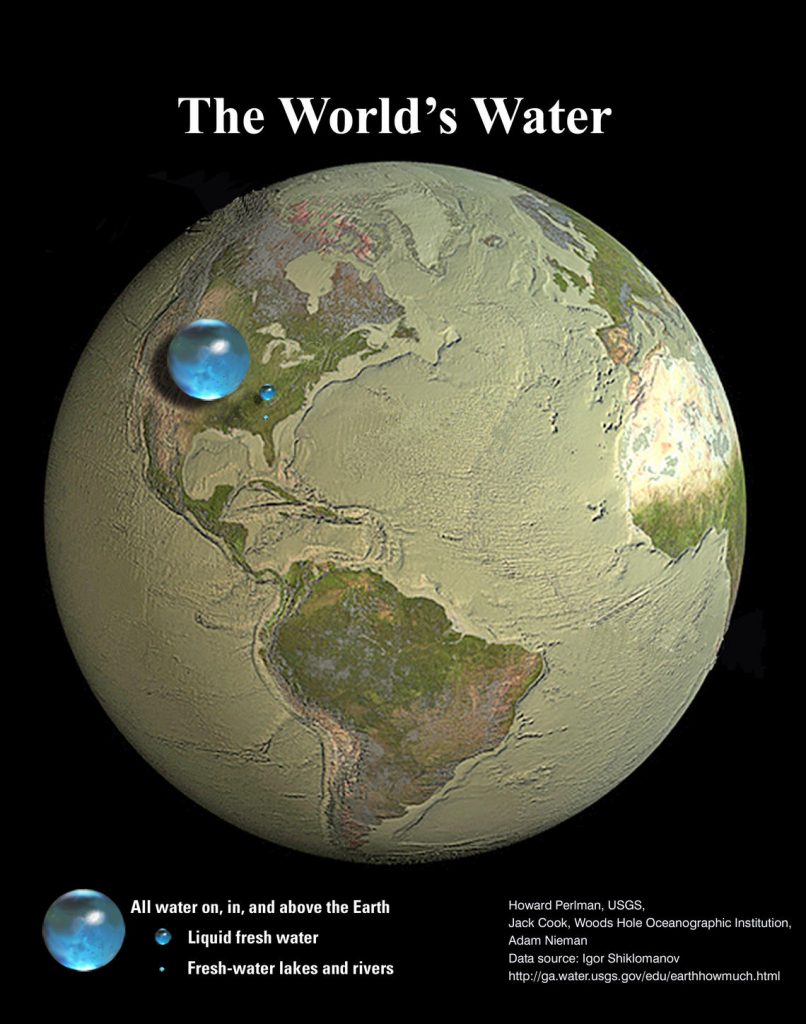
(1) All water (largest sphere over western U.S., 860 miles in diameter)
(2) Fresh liquid water in the ground, lakes, swamps, and rivers (mid-sized sphere over Kentucky, 169.5 miles in diameter), and
(3) Fresh-water lakes and rivers (smallest sphere over Georgia, 34.9 miles in diameter).
(Credit: Howard Perlman, USGS; globe illustration by Jack Cook, Woods Hole Oceanographic Institution (©); and Adam Nieman.)
Think about it those two small dots, 75% of it is already being used up just for crops and livestock. We are only protecting 3% of these small dots overall. Does that seem sustainable to anyone with a growing population expected to reach 10 Billion by mid-century?

I haven’t visited the ocean depths in some years now. It is certainly not for lack of deep appreciation of the essential life that exists there. There is no where on this planet where you feel a more primal connection to the origin of life as we know it.
Visits there are not without some sense of guilt accompanying the self-gratification. Guilt that for each of those breaths and sips of water I take every day, I have accumulated a debt I doubt I can repay. Guilt that knowing traveling to such wondrous places belches more CO2 into the atmosphere, in part causing the very acidification threats to reefs around the world. Reefs that may not exist by mid-century with another 10 Billion humans consuming those precious little drops, traveling more than ever.
The fact is, there isn’t a single day I don’t think of the oceans, despite the lack of compressed nitrogen in my veins. I am extremely fortunate to have experienced some of their wonders first hand and up close. It is impossible to convey those experiences in any photographs. Last year I wrote proposing we trade Christmas for more priority to the oceans. Seems the world didn’t listen to my little voice in the wilderness.

One can only hope for this World Ocean’s Day, people will stop everything they are doing and think about those tiny little drops on that big brown sphere. Think about what we are buying, what we are doing, how we are voting. We may not be able to see very far into the depths of the deep blue. Our very existence however, depends on our ability to look deeper than we can see.


Each day I become more aware and frightened with the direction we are headed with our environment. I work at my part, what I can do to reduce my impact. However, I’m not near as outspoken as I could be and will even say should be. Great post, Mark!
I think it’s great whatever individuals can do on their own, but I don’t hold any hope that individual actions will be the solution to all of this. Systemic changes, laws, and environmental costs need to be factored into worldwide societies. That is such a huge undertaking, one I am not sure we as a species are capable of. You see good being done in one place, and bad in another that seemingly wipes it all out. Hard to keep a positive head about it.
Wonderful post….amazing images.
Thanks Howard.