


Fifty-thousand watts! That is an amount of power that I typically only associate with some warning on a big red sign at an electrical plant or the laboratory of Dr. Frankenstein. Yet, on a regular basis, I now see it on the dashboard of my car. Only I am not trying to power a small village or resurrect an assembled corpse, I am just driving from point A to point B. Occasionally I see that I am using that much power, occasionally I see that I am generating that much power.
For the average person, having a tangible concept of electric power is somewhat of an abstract thing. With respect to driving, we often relate to the volume of fuel we pump into our cars or overall horsepower that we can feel upon acceleration. A gallon (or liter) of this liquid is much easier to visualize than the energy stored in an 18.4 kWh battery pack. (kilowatt what?) A certain amount of gas equates to us being able to travel ‘X’ distance. A certain horsepower will equate to excitement in acceleration or the ability to tow stuff. I will go out on a limb and assume that is all most people relate to versus the amount of energy involved.
Even in our own homes, many of us don’t actively monitor the energy (kilowatt-hours) we consume on an average day. We may make note of it when it comes time to pay the electric bill. (A kilowatt-hour is a unit of energy required to sustain 1 kilowatt (1000 watts) for 1 hour). We might buy Energy-Star appliances, but pay little attention beyond the initial certification sticker. Most people know by now a LED lightbulb can produce more light at a small fraction of the power consumption of an incandescent 60W or 100W bulb. But we are really kind of clueless about the amount of energy required to power a car. It’s a lot.
This whole quantification of electric power really was placed front and center when I began driving a plugin hybrid (PHEV) car in 2017. Most of my thoughts were still around “how far can I go?” – the typical question I am often asked. But as the power meter begins to quantify this for you, you start to understand why batteries to power a car, even a small one, are so large.
Chevy Volt Plugin Hybrid
I have been driving a Gen 2 Chevrolet Volt Plugin-Hybrid car (PHEV) since 2017. And now with 3 years of driving it under my belt, mostly on pure electric power, I’ve formulated quite a few thoughts and opinions about electric / hybrid vehicles. With most of my photography being local and close over the past 3 years, I haven’t put that many miles on it either. It is a transition vehicle for sure, allowing you to dip your toe in both worlds for a while.
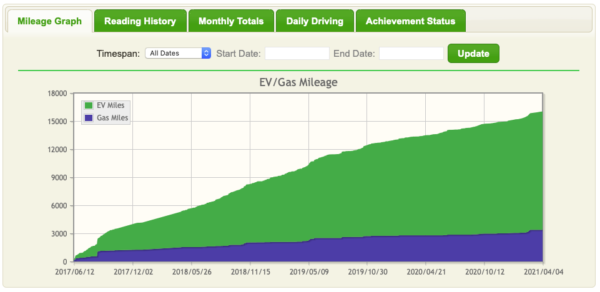
Chevrolet sadly no longer makes the Volt, the last one sadly rolled off the assembly line at the Detroit Hamtramck plant in 2019. It has a very large enthusiast community, yet never amounted to much in volume sales, despite government rebate incentives that took a big chunk out of the price. GM never spent much money in advertising it, despite many owners stating enthusiastically it is the best vehicle they’ve ever had. If it isn’t for environmental reasons, many drive it for economical ones. Electric, or even partially electric vehicles, require less maintenance, and of course, can go a long time without using a drop of gas. Because the electric motor also helps to act as a “brake” – it isn’t unusual to get 100,000 miles on a set of brake pads.
From the rumor mill, I understand that the cost of manufacture played a large part in the decision to cancel the model. I suspect they were actually losing money on each one, and why advertise to sell more on something that is a net loss? The engineering in making the fully electric and fuel power systems work together so seamlessly is very expensive. It is also highly impressive from a design aspect and quite complicated. So if the future is ultimately fully electric, why spend more capital investment on producing such an expensive option? Still, these plugin hybrids, still made by other manufacturers, really help people understand and make the transition versus a full switch.
For anyone wanting to really get to know how it works, this video of the Gen 1 vehicle does a good job. Gen 2 made further improvements in extending the battery-powered range and no longer required premium fuel. Just watching this explanation of how the combination electric/gasoline systems integrate makes it pretty easy to conclude how much simpler (and less costly) an electric-only system is.
The different types of electric/hybrid vehicles
For those unclear on the different types of battery integrated vehicles out there today, here are some basic definitions:
- An ICE vehicle (Internal Combustion Engine) is a term often used to refer to conventional gasoline-powered vehicles
- A Hybrid vehicle consumes gas all the time, only it consumes much less and does it more efficiently with a battery assist. It does not require charging. (Toyota Prius is the most popular of this type)
- A Plugin-Hybrid vehicle (PHEV) requires charging to run on electric power. It is capable of operating under full-electric power for a certain range, or in a hybrid way with gasoline and electric assist. In the case of the Volt, it doesn’t even have a traditional engine per se, it is called a “range extender” If it isn’t charged, it can still run on gasoline.
- A Battery Electric Vehicle (BEV) is powered solely by a rechargeable battery (Tesla, Chevy Bolt, Ford Lightning, etc)
Charging
This is an aspect of owning an EV or PHEV that has a lot of considerations and one that maybe doesn’t get enough practical consideration from policymakers. It is my opinion that being able to charge at home makes all the difference in the world in overcoming range anxiety often associated with EVs. Because the vast majority of the driving an individual does is typically close to home (30 miles (48 km) +/-), just plugging in when you get home helps turn that time your vehicle is parked into “refueling” time.

This is where that question of “how far can you go?” involves a bit of nuance. Many articles on charging EVs tend to focus on the time to charge from an empty battery to a full one, which can vary greatly depending on the technology it has. This is also perhaps the area of the most focus and development in bringing faster-charging batteries to market. So figures like 13 hours on 120V or even 3-4 hours on 220V recharge time should always be balanced with consideration that daily trips rarely fully drain a battery. Whenever you are home, your car is always topping off to a fully charged state. To put it another way – you are usually leaving home “with a freshly filled tank.”
This is also a big hurdle in EV adoption as there are many people who simply can’t charge at home. Maybe they live in an apartment, a condo with no chargers, etc. Of course, an infrastructure of public charging stations needs to be further developed, but having the convenience at home simply can’t be matched. I know many people have taken long trips using EV’s, but they do require a bit of planning. If you regularly drive very long distances and don’t have access to charging, an EV may not be a good fit right now.
120V vs. 220V
Many people wonder if you need to do anything special for charging at home, and that answer, of course, is “it depends.” There are generally 2 terms you will hear about AC charging levels – Level 1 and Level 2. Level 1 refers to standard US home voltage of 110/120V outlets, and Level 2 is a 220V line. With the technology of today, Level 1 full charge times are typically around 10-13 hours, and Level 2 charge times reduce that to near 3-4 hours. Teslas are another story with their DC fast charging tech. The recently announced Ford Lightning Pickup has this DC fast charging option also. Again, remember on average, you may rarely need to charge from a fully drained battery.
Perhaps the biggest consideration for charging at home is the current draw. While you may be able to charge your car on a circuit that has only some garage lights on it, you may run into problems if another high current device is used on that circuit while the car is charging (think hair-dryer, toaster, etc). I ran into this problem when I was using a Level 1 charger and found out the garage outlet was also connected to a bathroom circuit where my wife plugged in a hairdryer. 🙂
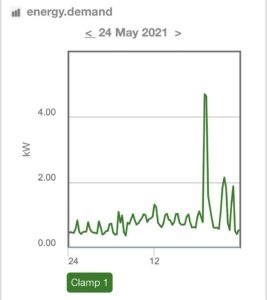
For a while, I was able to work around the problem by just setting my car up so it wouldn’t be charging in the morning. Ultimately though I ended up contracting an electrician to install a separate outlet, and upgraded to a 220V Level 2 line at the same time. It is also vitally important to make sure the outlets you are using are rated for prolonged high-current draws as there are plenty of photos online of charred and burned cheap outlets that were overloaded and represent a fire hazard.
Remember, charging at home isn’t free – energy isn’t free. Many utilities offer what is called Time-of-Day pricing, usually, something like 7 pm – 11 am, off-peak hours. You can set up your vehicle so that it only charges at this time, saving some money. Of course, if you have home solar, that is much better – you can claim you are running on sun power! But the initial investment in solar is also a consideration – again, not free.

Coal Power!
Any discussion on electric vehicles usually brings out more than a few Mensa candidates that comment “hope you like your coal-powered car!” This commentary comes in surges usually, especially after just finishing up Earth month. I do think this is a worthwhile discussion to have, but one based on the science behind such things rather than propaganda. Where this type of statement is misguided is that it fails to recognize the efficiency differences between an electric motor and an internal combustion one, as well as the dynamic nature of the grid.
The US Department of Energy put out this comparison: EV’s convert over 77% of the energy from the grid to the wheels while conventional gasoline engines only convert 12-30% of the energy stored in gasoline to the wheels. It’s like if you spent $100 on gas, getting $77 use out of it instead of $30 (at best). What a deal eh? I bet not many think about how much of their money goes into heating the air around them when they are filling up their gas tanks. So no matter what the energy source is, an electric motor is going to use that energy a lot more efficiently and less of it.
Use this fact in combination with studies by the Union of Concerned Scientists that analyze the makeup of the entire electrical grid to give an equivalent MPG of an EV depending on where you live. And because the grid is always changing, getting cleaner usually – they’ve had to update those studies to reflect even better MPG equivalents of EVs. When I first purchased my Volt, Michigan had about 50% of its electricity generated from coal. Now it is down to a third just 3 years later and dropping fast. Gas is always going to remain gas for the life of the vehicle, whereas an EV will get progressively better.
So the energy powering EV’s isn’t always “emissions free”, and that varies state to state. But even when the source isn’t renewable, it uses that energy to power the wheels in a much more efficient way, and ultimately much, much cleaner than a vehicle dependent on gas.
Batteries and Mining
This is another area that critics like to jump on, and on this topic – I tend to agree with the concern, except when used as a disingenuous whataboutism. I don’t think it is talked about enough in the context of the exponential growth in EVs. As a recent report from the Union of Concerned Scientists discusses, the footprint of an EV is largely shifted upstream in its manufacture instead of coming from the tailpipe. This is a key statistic from this report:
Overall, manufacturing a BEV contributes about 70 grams of carbon dioxide–equivalent emissions per mile (g CO2e/mile) compared with 40 grams for a comparably sized gasoline vehicle. But because a BEV’s operating-related emissions (i.e., vehicle charging) are relatively low, he total global warming emissions for BEVs on the average grid in the United States are less than half those for gasoline vehicles (200 g CO2e/mile vs. 450 g CO2e/mile).
Union of Concerned Scientists report, Electric Vehicle Batteries
Addressing Questions about Critical
Materials and Recycling, Feb 2021
Critics typically cherry-pick the initial part of this statement, conveniently omitting the latter half. And again, as the “average grid” improves, so do EVs, their manufacturing facilities, etc. I not aware of anyone pushing a point that EV’s have zero impact but many do conveniently leave what the impacts are out of their analysis. That should change, keeping in mind on a relative comparison basis, they are much, much better than gasoline.
Battery recycling is another concern brought up in the UCS report. Very few facilities currently do EV battery recycling, and this area is prime for a lot of growth and innovation as long as we don’t get caught in a conundrum like some plastics. This would be a case where it is more cost effective to use virgin materials than recover and reclaim recycled. With concerns about labor practices and environmental impacts of mining, recycling these precious materials makes more and more sense, and should be incentivized appropriately.
Multi-purpose use for these large batteries is also beneficial towards increased adoption. The new Ford Lightning pickup can serve as a multi-purpose whole-home backup generator with close to 10 days of backup power depending on how much you use. I’ve read some pieces about the potential to turn EV batteries into whole-house backup generators at the end of their life because they typically have a lot of usable power left in them. However, I have yet to see anything in a practical sense considering the size and the various configurations. Another area prime for innovation.
Not perfection – but progress
Understanding that progress with the technology we have available today and the need to reduce our greenhouse gas emissions as fast as possible is really a key concept. Sure, we could wait until battery technology is much cleaner, faster charging, and lower impact. How long would that take? We could wait until the grid is totally free of coal (and natural gas). Then we have to go through the whole ramp-up and adoption curve, waiting for economies of scale to take place to improve the affordability. By then, surely our planet will be in a very dangerous place for supporting life as we know it. By then, it will likely be too late.

We still have many transportation sectors that don’t have economical electric options yet – think big construction equipment, airplanes, huge agricultural equipment, cruise ships. Without some revolutionary discoveries in battery technology, transitioning all of this stuff off fossil fuels may be decades away. There is simply no free lunch when it comes to the energy needs of a civilization covering the entire planet.
So I always leave EV discussions this way. A perpetual motion machine does not exist. It cannot exist without violating the first law of thermodynamics. We are always taking materials from one place and converting them into energy in another. A zero-impact option is simply fantasy. Using that type of logic to avoid the adoption of a significantly better way, even if not the perfect way, is a recipe for extinction. Especially when we know the root of the problems we are causing with our climate, acting now and fast is not only possible but necessary.
For many people, EVs aren’t a good fit just yet whether it is financial or usage needs. It may take a while before they are. We need to continue work on that. As the volumes ramp up, we must be vigilant in recognizing we still have impacts to sustainably manage. We need to do A LOT of work on our grid and infrastructure. If we do manage to electrify so many aspects of transportation – grid security and backup must become a TOP priority. I am pretty sure there will be mistakes and unforeseen consequences, because, well – we are humans. If we do nothing, then we damn well better be prepared for dealing with the consequences of doing nothing.
It is quite an exciting time if you think about it. We are going to see a lot of revolutionary inventions in transportation in the coming decades. I often tell people who ask me about my car that I can’t remember the last time I bought gas. I look forward to the day when that answer is years ago instead of months ago.


Thanks, Mark! An EV is certainly in my future and was considered at my last purchase but like Earl mentioned, the infrastructure wasn’t where I needed it then and the charge times just didn’t work for some long road trips in the open spaces of Utah or New Mexico. I’m seeing more and more “Electric Pumps” now and when we finally arrive in Maine this summer it’ll be something we will once again consider.
That was a very informative, well-reasoned article and I’ve bookmarked it for further review. Thanks again.
I’ve often wondered if solar charging stations make sense for those remote spots. Not only just for vehicles, but for charging devices, etc.
A great and timely post, Mark. A BEV probably makes sense for more people now than most of us (me included) realize. However, many will not be comfortable making the switch as an only vehicle until there is a higher level of supporting infrastructure. It may be a bit of a chicken, or the egg situation in that infrastructure investment probably won’t fully happen until there’s a much higher number of BEVs on the road. I wish there were more co-development on some of these projects along with shared common standards. ( I always thought “refueling” stations with automated 5-15 min battery pack swaps done from beneath the vehicle would be a neat concept/capability. ) However, I’m excited to see some of the new vehicles on the cusp of being introduced, and my feeling is my next vehicle will be a BEV. Of course, that may be a few years down the road.
It is a little chicken and egg. And for sure it seems the better bet is on the DC fast charging. Nobody is going to want to wait around so long. Which is why charging at home is really the best deal.
I liked the battery swap idea also. I thought Tesla was going to do that at one time. But having one that can accommodate all vehicles is a pipe dream.
It would be cool to see a BEV-RV! 🙂
Travel trailer behind a Ford Lightning. Ta-da! LOL
Haha. I haven’t seen how much towing impacts the range – I wonder if it is similar to impact on ICE towing or better overall from the electric motor?
Estimates I’ve seen show towings a big impact, perhaps even more apparent with a BEV than with an ICE. But that would promote “Ultra-Light” Travel Trailers. Perhaps there could be additional battery capacity built into the trailer, which the tow vehicle could utilize when connected but could power the trailer when parked. Plus, there’s a lot of slow charge solar possibility with the surface area on top of trailers. Endless exciting possibilities!
Good idea. The trailer likely needs its own power source anyway. I once read some estimates about solar trailers – and given the current efficiencies of panels – you’d need a trailer the size of an 18-wheeler of panels or so to make it work. You might even have some RV parks pop up that have their own wind turbines and solar farms.
Thanks for a really informative discussion. I currently have a hybrid but suspect my next car will be electric. It really looks like that’s the future.
I know I’ll never buy a gas powered car, or anything again.