


The array of answers is interesting whenever I see the questions regarding signing photographs.
In an older podcast by Brooks Jensen on signing prints (LW0025), he asks some probing questions and acknowledges no resolving answers. Even the ‘traditional’ art community has different methods across various media. This post explores how to sign photos and the reasoning behind it, then provides some recommendations on the best pens to sign with, as I have gone through plenty.
Art is never finished, only abandoned.
Paul Valéry
How to sign photo prints, canvas, and metal prints
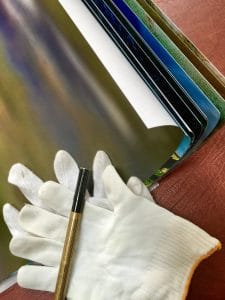
There is no shortage of opinions on how to sign a photo. Some people sign the mat, some sign the print off of the image, some on the back, or, like me, sign directly on the image itself. It’s amazing (or amusing) to see the strong positions on “the right way” that anyone must sign their artwork.
The answer should be simple. It is your photograph and your signature. It is your choice. I offer you some things to think about when making this decision, as, ultimately, it can impact the provenance of your work. With so few photos printed in these digital times, finding one with an actual signature can be pretty valuable.
Offering Value and authenticity
If you are selling your work, from a consumer’s or collector’s standpoint, it is a common desire to have it signed in some way. Watch any episode of Antiques Road Show, and a signature has clear value. It is the start of the provenance of the piece. Therein lie two distinct viewpoints on signing photographs – of the artists’ intent vs. the value to the owner of the work.
Does having the artist’s signature separate it from something from a mass-production factory? Does it make it appear more authentic? I think everyone has their reasons. It is a final stamp of approval, ready to be released into the wild.
Signing mat boards
Although commonly done by some “old school” photography masters, I don’t see much value in signing a mat board. If a matboard is damaged and needs replacement, guess where your signature ends up? So much for the provenance of that photograph!
If you are working with another party, like an art consultant, they typically will have their framers lined up. It is a complete logistical mess if you think you MUST sign the mat board.
Of course, it isn’t an option if someone doesn’t order a matted print—many more choices today exist for displaying photographs, like on canvas, metal, or face-mount acrylics. The physical medium can play a crucial role in your decision. If you sign the back of a paper print, what happens when it is mounted? It comes down to signing on or off the actual image and media it is reproduced on.
Does it matter if it is visible or not?
Signing photographs – the final ‘stamp’ of approval

As Jensen mentions in his podcast, signatures can be talking points of the art collector – perhaps even a bragging point of authenticity. For the photographer, it may indicate that an image is finally at its final stage. The work has a final blessing.
I have seen many photographs displayed in public places with no visible signature. I wish they did, as I wanted to know who made the photo to learn more about them. It can be like leaving your calling card. A little Marketing 101, folks.
Furthermore, if it is a distraction to have a signature on an image, as some claim, why is it common practice for painters to have visible signatures on their works? Why accept the practice of one type of art and not the other? I think a photographer can take the worries about possible distractions into consideration. Sign the photo in a manner where it is an accent, not a focal point.
Jensen suggests using sound, consistent reasoning when signing your images. Don’t make it pretentious. We all put a lot of effort into composing a shot, to begin with, and perhaps even more effort into creating a final print. I have never seen anything wrong with showing pride and self-confidence in that. A collector will also want to see that.
Avoid the “anonymous” photograph
As I mentioned, I’m sure we have all been in a public space where we have seen a photograph we liked but didn’t know who made it. I’ve seen art in hospitals or medical offices that are beautiful – yet anonymous. How unfortunate for that artist! Thousands of people may enjoy that piece, yet the artist has no recognition.
Best Pens to write on canvas and glossy photos
These are pens or signing photographs that I have found work well on prints (glossy and matte), metal, and canvas: Sakura Extra Fine Pentouch

I use either gold or silver, depending on what I think matches the image’s tonality best. You can find 3-pack deals with three different colors on Amazon below (affiliate links). The copper color is an excellent option! The ink dries fast, and I have not seen it smear from packaging or handling after drying.
I can write smoothly on canvas, and they work very well on gloss/semi-gloss print surfaces. I prefer the Extra Fine 0.7mm version, as it helps create a nice, clean signature.

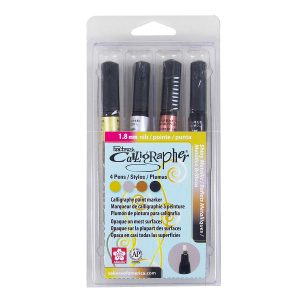
Sakura 47391 4-Piece Fine Pentouch Calligrapher Paint Marker, 1.8mm, Gold, Silver, Copper and Black
Tips for taking care of your pens
The only caution is that they will dry out quickly if you do not tightly cap them. The caps don’t stay on very tightly at times. I keep them sealed in a ziplock bag as a precaution after using them. Take care of these, and they will last a while.
Be particularly careful when pressing the tip in for more ink. It doesn’t take many presses to have too much ink run out, and you will find yourself with a drip hazard. I always do a practice signature on a piece of paper first. Having a few on hand at any time is undoubtedly a good idea, as you never know when it will finally dry out and stop working.
I hope you found these tips to be helpful. I have tried several brands over the years and always return to these Sakuras as the best.
Feel free to share some of your success or disaster stories about signing photos in the comments below.


I used to use an archival quality gel pen for most prints but all of a sudden the fine point version was discontinued and the medium point pen just looked too sloppy. I’m a big fan of the Sakura now, though they sometimes are still too broad for signatures on smaller prints. Have you found anything that works reliably on aluminum or acrylic prints?
The Sakura works well on metal. Although for acrylic, I usually digitally sign the print because the acrylic goes over the top. For the Sakura, be sure to use the extra fine version if you have line thickness issues.
I have framed and signed several of my photographs and can agree with the angle that at this point it is ready to seen by the world. aswell, as someone that signs the mat I believe that the frame and mat is a part of the art peice as this is how the image was intended to be seen. If it has been decided to remove the frame and mat along with your signature perhaps the peice no longer warrents your/my endorsement. Just my thoughts I would be interested in your own.
When ever I did a pencil portrait, I signed everyone in front on the right. Now since I have started freelance photography (I love it, exspecially when some one says ”I love your pictues and buys one to four at one time” so I agree be proud of your work and results that your eye visualized and produced. Yes i say sign, sign, sign and always sign your work in front. I used a thin paint pen to match the photo colors.
I am glad I found this web site. I started to sign some of my photographs last night after purchasing a few liquid gel type pens (silver, white and black, depending on the photo). I signed them on the lower right corner and above the matt. I do sign in pencil the matt, but now I feel that’s not necessary. I also sign the back in regular ink pen with the date, location of photo, etc.
For some photos I display in my house (5×7) I just used my initials ‘mjp’ as they are too small for my signature.
A friend of mine, who is a professional photographer, got me into the idea of signing the front. He stated, “It’s your art work and if you are proud of it, it should be signed.”
I do like the idea of getting a stamp with my name and “copyright” for the back of the photos.
Monica
Since I have received many inquiries about what I use to sign my prints (and also canvas) – I updated this post with the pens I have found work really well. They dry quick, and the gold or silver metallic shows well without being too intrusive.
The only thing that might worry me about a signature stamp is that it might be interpreted to be too much like mass production. I know for each of my prints, the signature varies just slightly, and I think that is part of the appeal of ‘personally signed’ artwork.
I wouldn’t consider signing the work given as a gift to be pretentious either.
Olivia… i have given several of my photo collections as gifts… and i have found that the receipients of my work have truly appreciated having it bear my signature… that it is a personal work done by me and given to them to enjoy. i do not think it is showing off to sign photography that i have taken and want to share with someone special… and as the writers above agree… it is a piece of art… why not sign it if you are proud of it and claim it as your own work!!
p.s. i did purchase a signature stamp with perma ink and it works perfectly.
I have just started getting into photography and I am wondering if the same rules apply to give a photo series as a gift. I am printing and matting photos as a wedding present and don’t know if signing them seems pretentious or a personal touch for the gift?
Mark:
thank you for your response… the liquid gel pens are very popular… have metal tips and .7mm ball so is very fine… Pentel is one brand that i frequently buy at Staples.
my question is – – if i purchased a pre-inked stamp of my signature… will this ink dry without smudging… and stay on the glossy photo paper permanently?? is there a recommended brand of stamp that is better than others??
or is it just better to individually sign each card with pen and ink regardless of how much my hand starts to ache?
Debbie, I think it is up to the individual. I certainly am familiar with ink stamps, but have never seen any like a liquid gel pen.
i am an amatuer photographer embarking on selling my photos… i have been signing the photos on the bottom right side of the print… using fine point liquid gel ink… is it possible to have a signature stamp made up that would use indelible ink that would be like the fine point gel pen??
i sell greeting cards… and i have numerous quanities to sign.
any suggestions?? i print my pictures at an imaging store so do not have a computer generated program to digitally sign each photo.
I always questioned how to sign my photo work. I finally started to stamp the center of the photo on the back and also use a copyright symbol. This protected my work as nobody could crop in my work and eliminate my signiture. I also sign the mat as well on the right corner and the name of the photo on the left. I think I have covered it completely.
Here’s my two-cent’s worth on this subject…
I used to sign the mat, then realized how silly that was if someone discards the mat. And as you said, signing the back seems a bit odd, as in, what is the point?
Because my penmanship really isn’t something I’m proud of, I’ve adopted a particular “font” as my signature and use it lightly on the lower right corner, sampling a color found within the photograph so it doesn’t clash.
Then if someone asks me at the point of sale to sign the image, I sign the back of the matted print where the information about the image is as well.
Great shot as well. I can’t wait to see one of your prints!
I totally agree that prints should be signed. When I start printing my work I will not sign the original until after it is printed and sign the prints in such a way as people will know they are prints. Some of my paintings have so much texture that it is hard to sign them. I also put a registration tag on the back of everything I sell that helps the purchaser in a myriad of ways.
I sign prints on the photograph, not the mat, usually bottom right. It’s a claim of authorship – “I made this.” A form of branding. Perhaps with painting it indicates the piece is finished, not so with a photograph. I’m always tinkering with prints. But once signed, one my prints is off on its own in the world, in whatever form or appearance it had when I released it, somewhat different from other versions as it may be.
Bernie, you make so many great images, I am sure your restaurant and office clients would see value in having signed pieces from you. It is not that it is right or wrong, just a lot of intriguing aspects of the hows and whys we sign our work.
I always felt self-conscious about signing my work, I have no idea why, so now when I sell to a restaurant or office I don’t even sign them. I do sign them when I sell to family or friends. You think thats wrong , I am glad you brought this up, I have always wondered about this as well.
I am a painter and as such I sign my paintings – signature means the painting is finished.
Why should I do something different on my prints? It’s the same process – a “finished” photo – ready to leave.
The only difference between painting and print is that I put a label on the back of my paintings with all the necessary details – on the prints I write directly on the back as a proof for authenticity.
My signatures never interferes with the image and I tend to use a matching colour – nothing extravagant – neither on the painting nor on the print. It never came to my mind why I should NOT sign a piece of my work. Signature simply means identification with the work – nothing more and nothing less.
I have seen, as you suggest, many different ways of signing. I do sign….because I feel it indicates a finished piece and, as you suggest, as a ‘sign’ of pride in the work.
I sign just below the image on the white paper to one side. I also write the title of the image. Of course, that implies that the image should be matted in a certain way….with a 3/4 inch or so border of paper exposed around the image. Bu similar to signing the back, if someone doesn’t want it that way they can always cover it up with the mat.
Lots of ways to do it. I never trust anyone that says there is only one correct way!