


Black and white photography is prevalent with landscapes, people, photojournalism and so many other types of subjects. Why is it then that we rarely see black and white images of birds (among other wildlife)? Is it because birds are generally very colorful in their own right that showing them in monochrome somehow robs them of their beauty?
Black and White Bird Photography
As with any subject in black and white, we tend to focus more on textures, shapes, and forms. Certainly, birds have all of these characteristics and should be no different than the other ‘well done’ black and white subjects. When I wrote my previous post on Seeing and Letting go, I mentioned that birds have a pretty tall ‘creativity ladder’ associated with them in my opinion. I did a quick Google search on black and white bird photography, and I turned up very little in the way of actual monochrome photographs. So perhaps this is a rung worth exploring a little more.

And coincidentally, while doing some browsing on creativity tools and thought starters, I came across this new black and white conversion technique <link removed due to article no longer exists>. It is labeled as what Greg Gorman uses (or used to use), who is most well known for his great work with models and actors. It is quite different than many black and white conversion techniques, but I find it yields some very rich, deep tones. With my own set of models and actors, I began to play a little and was pleased with some of the results. I don’t think you could have better candidates for black and white photography than puffins and razorbill auks! After all, nature has already done most of the work for you. Cool stuff!

•••
Update… Given the article I referenced for this post no longer exists on CreativePro, here are some of my other B&W tools:
- Topaz B&W Effects – Capture the Essence of your photos in black and white LEARN MORE
- Nik Silver Efex Pro – now owned by DXO Labs
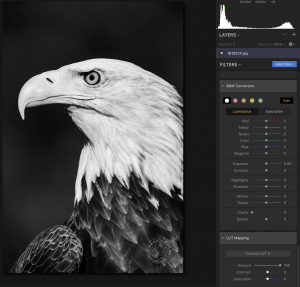
- Luminar B&W Conversion module – just a small example of various tools in Luminar
I want to say thanks again to all the great visitors I have here. By sharing your comments, thoughts, and ideas, you have made this blog richer than I could have ever done.
>> see more bird photography in my Wildlife Gallery


Those are some great looking photos, there definitely arn’t enough black and white bird photos out there and the conversion on those looks exellent.
With animals, I think you have to be more selective in the image you choose to go BW with. A lot of animal shots can lack tones in areas where they are needed to add impact to the image. For example, the first bird picture you use doesn’t work for me; you can’t see the bird’s faces and so they look like black blobs in the image. The second bird picture looks gorgeous in BW thought.
Thanks for sharing the BW conversion technique, I’m always looking for better ways…BW has become one area I have been forcing myself to try more often.
Thanks guys. One of the things I find interesting about this ‘new way’ is that it does discard all the color information in the convert to grayscale step. A lot of the techniques today consider that a big ‘no-no.’ But upon trying it with several images, I don’t see any big issue with it. In fact it gives quite a rich conversion. A curves adjustment layer is usually needed to bring some brightness back to the whites.
Nice post. I always love to read about black and white processing so thank you for the tip! I love your conversions. I like strong blacks and strong whites in B&Ws too.
I will have to give that a shot Mark, I usually just use the channel mixer and I am not always happy with results. The birds look great, the tones have such a deep look there not washed out like some of mine tend to be, thanks for the info.
Mark thanks for tip and the heads up. I’m not sure why I haven’t done any conversions to B&W for animals. I seem to have no problem doing it for everything else! 🙂 I’ll certainly give it a try.
BTW, these two shots are perfect for B&W. Wonderful.