


Milkweed is quite an interesting plant. From its budding and flowering to attracting monarch caterpillars, to the eruption of its seedpods in fall – it offers quite a bit to explore. This plant is critical to the life-cycle and defenses of the monarch butterfly. By consuming the toxins in this plant, caterpillars and ultimately the butterfly is distasteful to eat by predators.
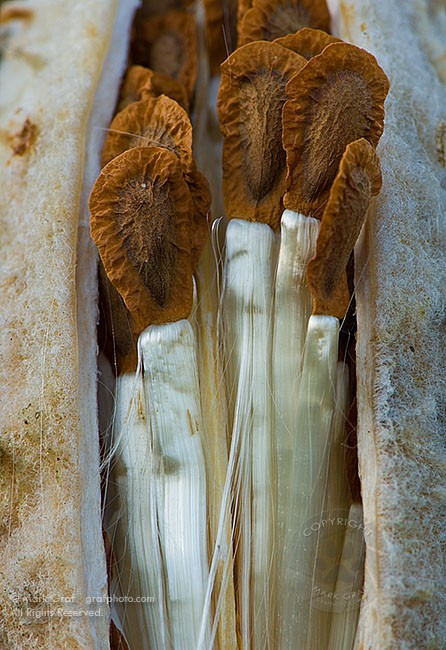
Today I did some exploring of its seed pods in a field about a 5-minute drive from my house. It can be challenging to find a pod and seeds that are somewhat in the same plane.
Photographing Milkweed seeds
Having the elements within the same plane helps you maximize your depth of field available from the lens you are using, especially when doing macro. So it helps to have a field of a lot of them to choose from. Keep a close eye on how parallel your camera back is to your subject. The more parallel it is, the wider open apertures you can use – reducing diffraction effects from your DSLR and distracting background elements.
Not many plants offer nearly year-round photographic opportunities. So if you have some patches of milkweed in your area, return to it throughout the year for the changing subject matter it offers. More milkweed photos can be found by using the keyword milkweed on my gallery search page.


Interesting , beautiful photo , I like the contrast between the rich emerald green of the leaves and the striped caterpillar feeding on it.
I find the factoid you gave very intriguing about the caterpillar assimilating the milkweed’s toxins to make it unpalatable to predators once it becomes a monarch.
Mike, they are ‘well popped’ at 17 mile & Utica.
Thank you all for the comments.
I, too, enjoy milkweed year round and have a meadow full of them. They are not easy to photograph well, and I love your photos of the pods!
Hey Mark, I’ve been shooting the seed pods from the Butterfly Weed, The seeds look the same but the pods are a lot thinner than the Milkweed. I’m been waiting for the Milkweed at Stony to pop. Should be soon.
I’ll have to try and plant some of this in my butterfly garden. Great tips.
Milkweed is something I happen to know a little about. Milkweed, or Asclepias, is a large genus. It formerly was in the Asclepiad family, or Asclepiadaceae. Asclepiad genera include not only Milkweed but also Vine Milkweed or Cynanchum and Climbing Milkweed or Sarcostemma. There are several species and subspecies within each genus.
But here is big news from the world of botany. Recently, the Asclepiad family was moved into the Dogbane family, or
Apocynaceae. I believe they all have the white sap in common.
In the southern California desert where I hang out, perhaps the most common milkweed is Rush Milkweed or Ajamete. After the heat of summer fries the wildflowers of spring, Rush Milkweed continues to flourish in the hot sun.
Rush attracts a variety of insects and of course this should be of great interest to photographers. My collection includes closeups of a brilliant red milkweed bug, a tobacco brown tarantula hawk wasp, and a red assassin bug murdering a black leaf-cutter bee.
Bill
Great shots Mark, I will have to take a closer look next time I come across a vine of them.
I was thinking of cultivating milkweed of some sort in my yard, and now I’m even more interested in doing so.