


Happy Arbor Day! Many people celebrate Arbor Day by planting a tree (or trees), which is wonderful. Picking the right tree for the right place is important. This is especially important in urban or suburban planning situations where you want to achieve the best value for the investment. You certainly don’t want a tree that grows too large for the location, cause an ultimate hazard, or be ill-suited for what you expect from it. Did you know there is a wonderful online tool that will help you decide what type of tree to plant, depending on your location, and what you expect from it (carbon storage, air pollution reduction, water absorption, shade, etc)?
What tree to plant?
Backed by peer-reviewed research and data from The Davey Institute, The USDA Forest Service, The Arbor Day Foundation, and other research firms, the iTree project packs a lot of helpful information and science into a single website –> iTreeTools.org. The iTree suite of tools originated in 2006 and now has a worldwide user-base, with over 285k users in the US alone. I only touch on a couple of the tools in this post and a very cursory review at that. There are, no exaggeration – hundreds of pages of manuals on the various tools.
Their species tool is one that provides a list of tree species suited to your area’s hardiness zone cross-referenced with the priorities you select. Here is a list of qualities that you rate on a scale of importance from 0-10;
- Air Pollutant Removal (which you can be specific about CO, NO2, Ozone, SO2, and particulates)
- Loc VOC emissions
- UV Radiation Reduction
- Carbon Storage
- Building Energy Reduction
- Wind Reduction
- Streamflow Reduction
- Air Temperature Reduction
- Low Allergenicity
You can also set parameters of minimum and maximum height if you have those restrictions or needs. So you can get very specific on your objectives, taking some out of consideration by marking them a “0” and giving others values closing in on the top priority of a “10.” The tool then outputs a list of tree species suited for your area based on your criteria. You can take the general good activity of “plant a tree” to an entirely new level based on science. Right tree, right place.
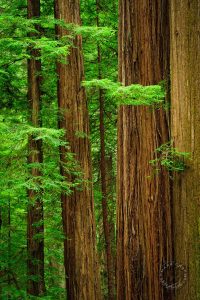
It can also be highly educational just for research purposes. For this study, I wanted to know what types of trees for my area would be best at Carbon Storage as the Number 10 priority, and I gave all the others “0.” Here are the top 10 suggestions. I did find it interesting a Giant Sequoia falls into my hardiness zone of 6, but I highly doubt it would be suitable for my location in Michigan. The woods behind my house have many Eastern Cottonwoods and American Sycamore trees (the featured image of this post), so it is good to know they are some of the best when it comes to carbon storage.
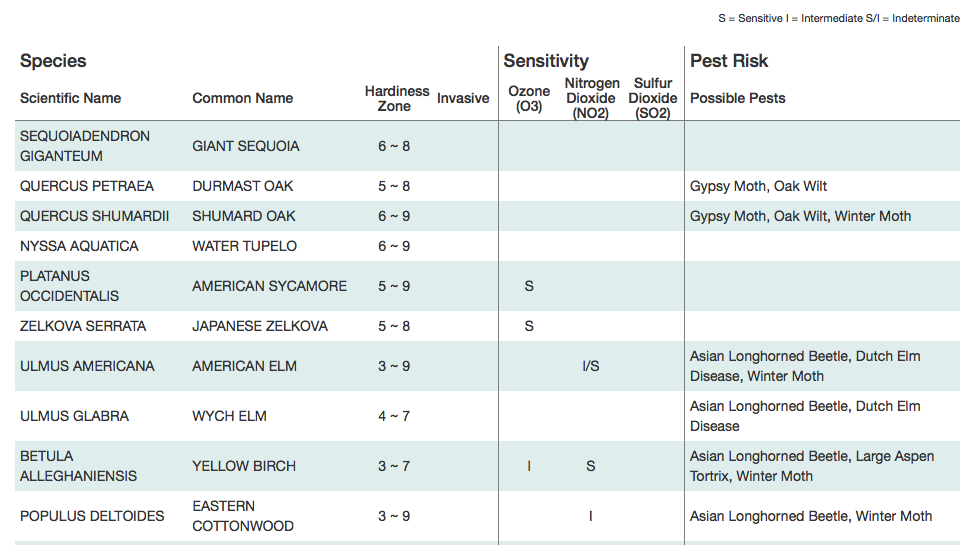
It’s worth noting that trees that rank well with one parameter may not be at the top of the list for another closely related one. For example, in the above list, I used Carbon Storage as the only important parameter. I changed it to Air Pollution as a “10” and left Carbon a “0” – and the list changed to be mostly Hemlock trees in the top 5. As you can see, you can really have some fun playing around with this in finding out which trees are best suited for particular jobs.
What is a tree worth?
I can picture Muir or Thoreau sitting on a rock contemplating this question for days on end. I could sit right there with them when it comes to the philosophical pondering of that question. After all, some trees are simply priceless. However, as it turns out, there are some real, tangible data on what trees do for us and the environment. Planting trees can be expensive in volume. And, when it comes to municipal or commercial investments, many decision-makers would like to know what is the justification in real data when it comes to making those investments, beyond the more esoteric “soul-healing” aspects.


This question is actually how I eventually stumbled onto the iTree suite of tools. I was reading an article that gave some data in US Dollars about a single tree’s contribution. Once I got past the fact we sadly assign currency equivalents to things of “value,” I took interest in how the articles calculated the values. That curiosity led me to iTree.
Another tool in the iTree suite is MyTree. This tool gives you numerical data on a specific tree that you input and provide data as far as its size, location, general health. If it is near a building (or say your house), it asks for that information also – which helps calculate energy savings.
MyTree
The tool also provides specifics on mitigation of water runoff, carbon dioxide sequestration, and air pollution removal. And remember, all of this data is backed by peer-reviewed science according to the iTree website. So you can have more than a bit of confidence in data being provided. Of course, parameters such as “tree health” play a part in these figures. Some approximation is going to be involved if you aren’t a certified arborist. In glancing at the manuals and other tools, I also gather this is a light version for the sake of simplicity.
I admit when entering data for one of the huge Dawn Redwoods in my yard, I was a bit disappointed at the total “value.” Clearly the trees mean a heck of a lot more than $41/year to me! Understanding this figure takes a little diving into the weeds of the values the programs use for certain things.
Take Carbon Dioxide for example. The program has to start with a baseline cost of carbon. This also involves picking a value for the Social Cost of Carbon – which fluctuates as we learn more about the destructive nature of CO2 building in our atmosphere. It is also influenced by politics. Nonetheless, I understand they had to start with a value, and I am sure there is much more in-depth reasoning behind it than my cursory look here.
But, look at some of the other values here outside of “dollar value.” The values are rather significant – nearly 400 gallons (1514 L) of rainwater and 363 lbs (165 kg) of Carbon Dioxide for just one tree. Having a yard full of trees obviously amounts to come significant benefits across the board. There are also tangential benefits trees provide beyond what these tools can estimate such as urban heat island mitigation, contributions to the mycorrhizal networks, and acting as “mother trees” to surrounding trees.
I have only scratched the surface of the information this wonderful website provides. On my to-do list is to map every tree on my property and feed my yard into the MyTree calculators. Stay tuned for that future post. If you find yourself wanting to explore more into the contributions of trees to your local environment – I recommend spending some time with the iTree tools.
Happy Arbor Day!
*featured image: American Sycamore tree, Clinton River Park, Sterling Heights, Michigan


I have the same issue, always needing to reenter my information every time I wish to comment.
I cringe at the thought of assigning value to any species but I know that is the way of it these days. As it happens I just ordered 3 hemlock trees and a redbud from the Arbor Day Foundation, and am waiting for them to come. We have a small suburban lot but between me and the squirrels there are now enough trees on it to call it a small forest 🙂 We don’t plan to stay here so I hope whoever buys the house appreciates the pines, oaks, hickory, walnut, etc that are now here. When we bought the place 25 years ago it was a muddy rectangle!
Thank you for restoring that little bit near you! We have a couple of Redbuds now, I am interested in some hemlocks perhaps. Running out of space.
On the comment information storage, I find it is rare my information is saved for any long period of time. I have keyboard shortcuts assigned that do my email and website so it makes it faster to populate those fields.
P.S. On retaining comment name, email, and web site info…I’m fairly sure in my case it’s my browser settings as I get the same results with Monte’s web site.
It may also have something to do with allowing people to use their WordPress logins on certain sites. I am not entirely sure. Unfortunately, issues like this are very hard to debug.
I wasn’t aware these tools even existed, Mark. Very interesting and I’m sure they are wonderful tools for many. Sadly I’d forgotten about Arbor Day. 🙁
I’ve also experienced the non-retention of personal data for comments but I always thought in my case it was probably because I have my browser cookie settings set fairly restrictive.
Well – no hard and fast laws on when you have to plant a tree should you feel the urge – now you know a good resource to use. 🙂
This is an interesting post, Mark. Found you statement true as our world has shifted to this idea that an inherent need to assign currency equivalents to things of “value.” We can include humans in that list, probably placing them near the top. It made me think about other plant life and what we can gather as their value to us. I almost planted a bunch of wildflower seeds around the outer edge of the condos. They would bring beauty, pollinators and a smile to a lot peoples faces. No monetary value in any of that.
I almost wrote something sarcastic referencing how some people in our political scene think they know more and will refute the data., but I won’t.
By the way, it seems my name,email and website information is not retained. I keep checking the box but always seem to need to re-enter the information.
No worries Monte, plenty of tolerance for sarcasm here. 🙂 I am not sure on the name saving bit – will have to check some settings. Not the result of a browser cache is it?
Not sure I understand. I have a couple other people i follow and don’t have a problem. But, if I’m the only one dealing with it then please explain more. I use WordPress and have a basic theme.
Ok, I am not sure what’s wrong then. Sorry for the inconvenience Monte. I have to do some more digging.