


Last Sunday, I finished a 9-day training course with the Climate Reality Project. It was virtual for the first time this year due to the pandemic, but also enabled them to train 10,000 new people around the world in a little more than a week. They join the existing 21,000 people who completed it in previous years. It was a great opportunity to connect with people in the Detroit area in our Zoom break-out group meetings throughout the week, as well as globally, who all share a passion for working on this critical issue of our time.
One of the assignments was to complete a Climate Story. People connect with each other through stories. While the facts and science are vitally important, people are moved to act based on sharing and caring about stories. Perhaps a bit more than charts and graphs. So I had to think back because generally caring for the environment goes back as far as I can remember.
But frankly, while I was in school, even in college, I don’t believe we ever learned about Climate Change, despite it being a concern going back 30, 40, 50 years. That’s different now, as climate change becomes a core part of any worthwhile school science curriculum. In thinking back, I found my connections with the ocean to be a beginning. Not only did it supercharge my interest in photography, but my passion for protecting the many creatures I came in contact with. While this story remains an evolving work in progress, I wanted to share at least this initial version here.
My Climate Story
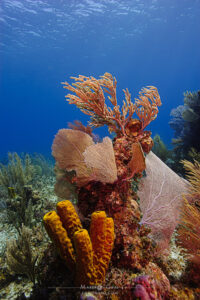
In 1993, I became a certified SCUBA diver. Shortly thereafter, we went on our first trip to the Caribbean to a small island called Guanaja in Honduras. Underneath the magnificent blue surface of the Caribbean lies an entirely foreign world to most humans. Few are fortunate enough to see such things with their own eyes, being completely immersed in this new environment. Watching it on TV simply cannot compare.
Fish swimming as far as the eye can see. Coral reefs that were thousands of years old teeming with little critters in these thriving underwater cities of life. In contrast to what we are used to seeing on land, where most living matter around us is plant life, in the sea it is animal life. Every shape, form, color, and size you can imagine. It is simply sensory overload, yet you feel a deep primal connection to this place we came from.

Fast forward 15 years, in subsequent trips to other places in the Caribbean and elsewhere, we saw changes. Less fish, more coral die-off from bleaching, less life in general. The seas were noticeably warmer. Everywhere the oceans are warmer. In self-reflection, the airplane we took to fly to these remote places, the cars on the islands we used to drive around, the food we were eating were all contributing to this destruction. Destruction of living creatures that thrived for thousands, perhaps millions, of years before we came along. Human beings, simply on a recreational adventure – even with an appreciation of the beauty of life around us, we were contributing to its demise.
That is a deeply disturbing and depressing revelation. What right do I have to contribute to the potential extinction of these creatures? And yet, I know as a single individual, or even a family that makes changes to their own lives does nothing in the context of the global problem. Even if we were able to get all diving trips canceled forever, it wouldn’t stop the problem. The energy use and lifestyles of the richest nations on this planet are contributing the most towards climate change.
A frequent argument is that the U.S. is no longer the largest emitter of CO2, other nations should “clean up first.” While this is now true from a total volume perspective today (The US is #2), the US far holds the largest cumulative historical contributions of CO2 into the atmosphere. It is irresponsible to suggest otherwise.
On our present course, it seems nearly inevitable we will hit 1.5 deg C without drastic changes in our emissions path. At at 1.5 deg C global temperature increase, the last IPCC SR1.5 report states:
Ocean ecosystems are already experiencing large-scale changes, and critical thresholds are expected to be reached at 1.5°C and higher levels of global warming (high confidence). In the transition to 1.5°C of warming, changes to water temperatures are expected to drive some species (e.g., plankton, fish) to relocate to higher latitudes and cause novel ecosystems to assemble (high confidence). Other ecosystems (e.g., kelp forests, coral reefs) are relatively less able to move, however, and are projected to experience high rates of mortality and loss (very high confidence). For example, multiple lines of evidence indicate that the majority (70–90%) of warm water (tropical) coral reefs that exist today will disappear even if global warming is constrained to 1.5°C (very high confidence). {3.4.4, Box 3.4}
IPCC Report SR1.5, CHAPTER 3
I simply find that unacceptable. Quite frankly, it’s horrifying.
Given I am here in this rich nation, emitting the most CO2 that will impact the poorest nations around the world, and the underwater creatures I feel a kinship with, I must use my voice and my vote to push for change. Change in our political will, change in our over-consumption habits, change in our energy future, change in our acceptance of science, change in our acceptance of responsibility, and change that will mitigate the existential risks to those underwater creatures I connected with 27 years ago.

We all have accumulated carbon sin. It now depends on how we will repent and begin to heal this planet and ourselves.
Featured Image at top: Photo collage of the attendees for the July 2020 Climate Reality Project Global Training – I found my own photo around the 9 o’clock position and marked with a red box.


The only way to save the planet is depopulation. Rapid depopulation down to about 1 billion. The planet will not support 7 billion people long term. What is coming soon: Desert areas will be too hot for people to live in, mass migration attempts across borders, the crashing of the ecosystem, famine, and wars over resources. The final wars. It really is too late to stop it. All because of the arrogance of humans….thinking we could breed and breed and breed without end.
I know that population growth is a concern, though I am not aware of any scientific evidence supporting what you are stating as the “only way” is true. The fact is, the areas of the highest population density in the world have the least responsibility for the climate crisis.
I’ll be attended next session of this program in a couple weeks. I’m excited that it has moved virtually, making a lot more accessible to more people. Looking forward to the experience! Any advice you’d share about the course?
That’s awesome Daniel! I am sure virtual session #2 will have some kinks worked out from session 1 that I attended. The website can be difficult to navigate to find things you are assigned to do, so have some patience. Set aside some time for a lot of videos, live sessions, and some zoom group calls during the 9 days. Gore does some great presentations – quite scary at first, but he wraps up the final one with some things to be hopeful about. Overall it opens up a large community of helpful people sharing ideas and presentations from all around the world. I found that encouraging. Please reach out if you have any questions as it comes up.
It seems I’m finding more young people engaged in and discussing climate change but like all of us we can’t just talk about it. It does start with how I live my life, what changes am I making and what changes will I make in the future. I then have a role model to show rather than my words. I remember an article by David Leland Hyde about some rally people were setting up at the mall in DC. He was questioning the impact of all the travel people were going to make in attending the march on climate change. I agree.
As I’ve gotten older my view of the natural world has evolved, some due to photography but mostly due to maturity of aging. I definitely see the world with a different lens than I did in the years from my 20’s to 60’s. We are in a pickle! I so wish I could snap my fingers and fix it.
I found it eye opening when I wrote just my story. Reflecting on where I came from and how I got to this present moment. How I live now has much to do with that story.
Thank you for sharing your thoughts Monte. I am not so concerned about protests if they help move the needle on action. I don’t think there is a single person that can claim to be a carbon saint. So purity tests are a distraction in my opinion. Everyone can help in their own ways and we could pick ourselves apart into eternity. Individual change is important, but systemic change is going to us more to where we need to be.
I kinda figured you would be the story expert here, so thank you.
It’s hard to believe that the most intelligent creatures on the planet may be the ones that lead to its demise. Sad but true. Hopefully we get smart enough before it’s too late.And as you point out that deadline is coming soon.
Intelligence is sometimes a matter of perspective. 🙂
True
“…before it’s too late”
I have to wonder, too late for what; to return to a healthy and balanced environment, lifestyle and economy, or to make enough changes to allow for the mere survival of our species? I’m not sure the first option is even a possibility at this point.
Was hoping for the first option.
I hope it’s still a possibility too, Howard. 😉
The pragmatic side of me thinks we should start preparing for some of the consequences versus waiting until the last minute. I know some major cities are already looking at massive infrastructure investments on reducing sunny day flooding. It’s hard. Pay now, or pay a lot more later. We seem to be naturally drawn towards the paying later part.
Congratulations on completing the training course, Mark!
As an individual trying to be eco-friendly but operating without consistent and accurate messaging and plan it’s hard to know what to do. I’ve read and seen situations where local actions thought to be eco-friendly turn out not to be when the broader and fuller picture is known. How many people are recycling when the reality is the recycling company may only process a small percentage of the marked recyclable product so 80% of what people sort, clean and put in their recycle bin ends up going into the dump eventually which is probably creating an even higher carbon footprint because of the extra steps and processing at the local recycling company. In many cases, there is a lack of consistent support, planning regulations and consistent inforcement at the state, federal and national levels. And don’t get me started about clean water and air. 🙁
I personally believe the best way to be environmentally friendly this year is to vote Trump and his environmental rapist out of office on Nov 3rd! Feel free to strike this if you have a non-political rule, Mark.
Political will is a big part of this Earl, so no, I won’t strike your comment. 🙂 However, I also recognize that really need EVERYONE to get on board with this. The extreme weather events, which are increasing in frequency every year, are non-partisan. Even if someone is perhaps not so much connected with the ocean, or doesn’t want the “government telling them what to do” hopefully will recognize the deep financial burden bailing out these disasters place on the country. Even the Pentagon / Department of Defense has issued reports detailing the destabilizing nature of climate refugees, food and water scarcity, which opens opportunities for extremist groups like ISIL to move in and take advantage of desperate people. So maybe this will resonate with people more concerned about national security threats. Also, people working in fossil fuels will need help in transitioning, again, bi-partisan job opportunities for growth! (As you can tell, I could go on and on… )
I’ve been disappointed with the recycling issues as well. And when plastic manufacturers find that it is cheaper to just buy virgin material than recycled, it points to the fact that the environmental cost and the social cost of carbon is not factored into our basic materials. When the oil is cheap, raw plastic gets cheap There is a problem with that. That is the problem with just leaving it “up to the markets.” It ignores the entire waste stream. What I am encouraged by is that countries, where we have been exporting our plastic and other waste to, have said enough is enough! We don’t want your trash!
There is still such a long way to go, but I found hope in connecting with so many people around our own country and around the world that want to find solutions. Thank you for your comments, Earl. It is a great discussion we need to have, here and everywhere.
Since we are allowed to be political….I find it refreshing to discuss politics with my politically and socially aware 21 year old daughter who has been home for months after her university has been shut down for Covid.
Asking her what the biggest political issues are in her Nd her friends minds, climate change was right up hear the top. ‘It’s not going to affect you much, but it’s going to affect people my age a lot.’
Indeed, Howard, I think younger generations are recognizing what a mess they are inheriting. That said, they need to vote. I heard a stat recently on millennial voters – when asked, about 80% of them indicated they were going to vote, but in reality, only 40% showed up. I wasn’t so involved with a lot of this at 21. It is encouraging to hear people like your daughter are engaged. I think the internet has helped make a lot of people more aware of global issues and concerns.