


It’s been one year since I returned to printing photographs at home with the replacement of my old, defunct Epson 4800 with a Canon Image ProGRAF 300 (great name 😉 ). The Epson was turned over to an electronics recycler and the Canon is slurping up delicious ink. But I haven’t really written about many of the experiences in this return after a long hiatus of printing my own, and as such, I thought it might make for some topics to write about. It remains to be seen if this develops into a series of posts on the printing experience.
Since I grew up with photography in an era of one-hour photo labs and 35mm slides – the digital workflow has always seemed to be missing a final output into something “real.” Of course, that’s just what the marketing and influencer types working with Epson and Canon want you to remember, continually poking at us with slogans about how the photo isn’t finished until it is printed. But marketing or not, it does tap into some truth as more of our lives move into “the cloud.” And yet, the vast majority of my photographs remain as nebulous pixels, bits and bytes.
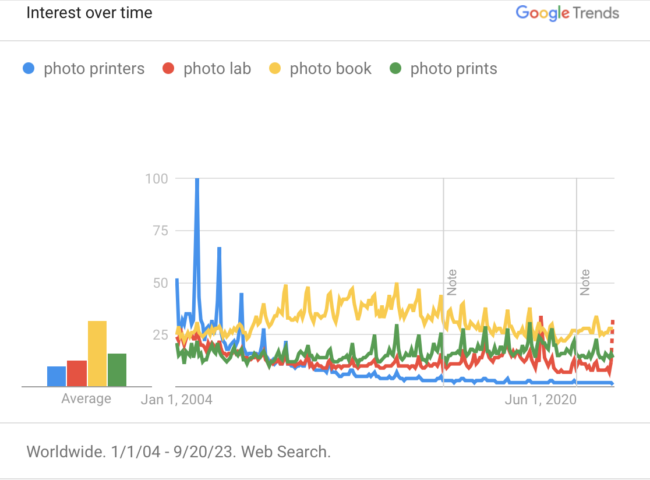
As a sanity check on my own personal march towards fossilization, I took a peek at Google Trends for some terms. It seemed to confirm my suspicions that while the desire to mess around with photo printing at home has declined, the interest in having a tangible output of photographs, memories, or gifts has remained somewhat steady over 20 years. Do you know where those spikes in searches mostly land? Around Christmas.
While the graph shows a general decline in photo printer searches prior to a significant technological introduction in 2007 – it certainly doesn’t recover after that. That introduction was the iPhone.
Smartphones / mobile devices / tablets became the new photo albums of course, along with social media becoming the new distribution mechanism. Other than those spikes around the gift-giving season, these devices and the cloud are perhaps the final destinations for most photographs.
Personally, I think the standard letter-sized paper of 8.5×11 is the happy medium for most fine art photographs. It is large enough to appreciate the finest details in landscapes, and small enough to appreciate the weight and feel of the paper. Stick it in a portfolio or leave it on your desk. There is a tangible connection to be had with prints of this size versus something large and unwieldy. It is a quiet, take-your-time, personal introduction to a photograph vs. a large, in-your-face display.
For me, a return to printing my own work served as a reminder of the joy one can feel holding a photograph in your hand. It allows me to evaluate an image in a way I cannot do on a screen. I can zoom in the old-fashioned way by bringing it closer to my face. It is something I perhaps lost touch with over years of increasing digital infiltration or wanting to jettison the hassles of dealing with ink, clogs, profiles, and mazes of menus. It’s a connection free from any baggage of likes, clicks, and algorithms. It’s a connection that cannot be trained on by generative AI. Safe from tracking cookies but perhaps not cookie crumbs. 🙂
In a following post, I’ll share some experiences with some fine art papers I’ve come to enjoy working with. Subscribe to this blog below if you’d like to be notified of when that drops. Let me know in the comments if you think the trend for printing photos, demand for photo books or other gifts will remain steady or eventually disappear altogether.


I like your take on the standard letter-sized paper of 8.5×11 to be your choice for a happy medium of fine art photographs. Since I have not printed and framed anything for years I had not even thought of that. You have easily convinced me that to be a good size. However, I have given my kids and grandchildren photo books as Christmas gifts the past couple years. I have a friend who shoots large format and the print is their thing. He will use his phone to take images then adjust his camera to get the image he wants. You have me now looking but the cost will probably prohibit that purchase. I will be interested in reading about your paper choices.
I suppose I just like something I can hold and look at easily. Of course there are benefits with the standard size, availability and cost – but I also think something like a 5×7 or 4×6 size is too small. So it is in the “Goldilocks zone.” (note to self: a term I recognize I should have used when writing the post)
Photobooks are also terrific Monte. Just something to bring …. pixels to paper. 😉
I am an avid printer and really enjoy the process of having my work transferred ‘from pixels to paper’ (great title by the way). I used to use an Epson but for many years have been using a Canon ProGRAF 2000 and much prefer it to the Epson. Looking forward to hearing your experiences and what papers you enjoy using!
Your many stories / posts definitely planted some seeds in my head regarding … should I? shouldn’t I? return to printing.
Maybe sadly, I do not event own a photo printer or a color printer of any kind. The few times I’ve wanted a print, I’ve farmed it out to a photo lab with acceptable (for me) results. Sometimes, I miss the connection and process, but my wallet thanks me. I do, however enjoy reading of others experiences.
I get that completely Earl. I just had this itch to move away from the digitized world, social media bs, AI, etc etc. And in turn, rediscovering some aspects I like about physical prints.
I’ll be interested to hear of your experiences with papers, Mark. I’ve been thru quite few and now think I’ve settled on a couple mattes but I’ve yet to find a glossy I’m happy with.
I have a feeling many papers I am trying are kinda old news to those that have been doing this on a more regular basis than me. My hiatus comes with a bit of catching up to do.