


The crunch of leaves, the solid smooth feel of American Beech bark, the smell of pine, the flickering light piercing the canopy, and the taste of fresh air, all encountered in a few steps. The sound of a nearby stream, a Great Horned Owl calls in the distance, the soft petals of an ephemeral woodland flower, the tartness of a wild blackberry enhance the rest of the journey. How often can we say we engage all of our senses for a simple walk in the woods?
For me, I know being more in tune with my environment helps in my abilities to see photographs, patterns, and ideas when I am wandering about. But I couldn’t honestly say I was consciously aware of all 5 senses being on alert at all times. This is an essential part of the prescription for effectively participating in Shinrin-Yoku.
People see a term like Shinrin-Yoku and likely attribute it to some ancient tradition. When translated to English, the term “Forest Bathing” may bring thoughts of some mystical tree-hugger mumbo jumbo. Both are far from the truth.
Origins of Shinrin-Yoku and Forest Bathing
The fact is, a government official coined the term for the Japanese practice in 1982, not a monk in a temple. A named practice that is only a mere 38 years old, but its principles rooted deeply in evolutionary biology.
The economic boom in Japan in the 80s created concern for the disconnection with nature. Economic growth took priority over Japan’s old growth forests. Cities were flourishing in their sprawl and populations. The Director of Agriculture, Forestry, and Fisheries Agency, Tomohide Akiyama-san, wanted to bring people’s attention back to nature. He wanted people to care more about its preservation, have people link their own personal health to the health of the forest.
This disconnection is just as prevalent in today’s society. “Nature Deficit Disorder” continues to be a concern worldwide, encouraging people to get outside more, learn more about their local environment. Perhaps one indication is found in my very own neighborhood where social media “alert” messages of coyote sightings are increasingly common as if to report an “intruder.”
Common sense tells us that being around nature is instinctively beneficial. The philosophy that mankind and nature are inseparable, at least in a healthy way, is inherent in Japanese and many other indigenous cultures around the world. We already know that being around trees simply makes people feel better. But why?
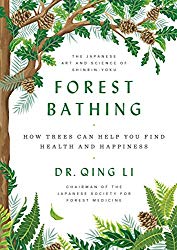
Dr. Qing Li has spent his medical career researching that very question. Dr. Li is the Chairman of the Japanese Society for Forest Medicine, and has become the authority on the practice of Shinrin-Yoku, aka. Forest Bathing. It is through Dr. Li’s research that the effects of quality time spent in the forest now has quantifiable physiological data.
Forest Bathing Health Benefits
Medical data from multiple studies around the world now shows that the practice of Forest Bathing shows improvements in these measurable health indicators:
- Reduce blood pressure
- Lower stress
- Improve cardiovascular and metabolic health
- Lower blood sugar levels
- Improve concentration and memory
- Lift depression
- Improve pain thresholds
- Improve energy
- Boost the immune system’s Natural Killer (NK) cell count
- Increase anti-cancer protein production
- Help you lose weight
While I am certainly not a medical doctor, I am not aware of any prescription or therapy that can offer all of the above benefits, and is also FREE. As I wrote about previously, it is no wonder that many communities are realizing this and making ordinances around protection of this tremendous health and environmental asset.
Dr. Li didn’t want to stop at just measuring the benefits, he still wanted to know why trees were providing these benefits to our health.
Healing elements of the forest

Trees have a chemical defense system to protect themselves from bacteria, insects, and fungi. Trees and other plants release chemicals called phytoncides to create a defense mechanism as well as a communication mechanism to surrounding trees. Humans become exposed to these natural substances when spending time in the forest.
Dr. Li’s research showed phytoncides, in addition to boosting a tree’s immune system, also boost the human immune system, more specifically Natural Killer (NK) cells. His experiments showed increased production of NK cells, as well as anti-cancer proteins perforin, granzyme A and granulysin by significant amounts. He went on to confirm these effects by exposing isolated patients in hotel rooms to oils containing phytoncides.
Isolated patients in the hotel rooms didn’t experience the magnitude of effects versus being physically in a forest, but the results were still positive and significant. It simply meant that there were other contributors in the forest environment.
Good bacteria
Medical research continues to explore the contributions of beneficial bacteria to our overall health. Dr. Mary O’Brien, an oncologist at London’s Royal Marsden Hospital, did research into a common bacteria in forest environments, particularly the soil, called Mycobacterium vaccae.
Her initial research wanted to find if this bacteria could help lung cancer patients. Those results were negative, but revealed something else. Despite not helping their disease, patients still reported improved cognitive functioning and energy levels.
Many other researchers studied this bacteria for its positive health benefits and found it stimulates the connections between our immune system and nervous system. It was significant enough to rival the results from antidepressants.

Fresher Air
Trees are natural air purifiers – they are great filters of atmospheric particulate matter. A Nature Conservancy study reports that particulate matter near a single tree can be reduced between 7-24%. The US Forest Service has calculated that trees in American cities remove $3.8 Billion worth of air pollution, prevent 670,000 incidents of respiratory symptoms and save 850 lives per year. Therefore a walk in the forest is most literally getting a breath of fresh air for your body and mind.
Making a Forest Bath count
There is no question that spending time in a forest has measurable improvements on our mental and physical health. It is important to note that many researchers remark that this time should be quality time. Forest bathing is not meant to be for exercise. In fact, researchers were careful in their experiments to rule out the health benefits of exercise by itself in order to isolate the specific contributions of the forest elements.
Dr. Li advises that the practice of Shinrin-Yoku should involve a very slow, meandering pace that allows you to focus on using all of your senses. Touch trees, practice deep breathing, look for nature’s patterns. Leave the devices, including cameras, at home. Allow it to be a place completely free of societal distractions. Li’s research indicates a 2 hour visit can create measurable benefits can last as long as a month afterwards!
I know my future visits to forests will now include a conscious checklist of senses I’ve engaged. Whether I leave my camera at home, however, may require a bit more discipline.


Preaching to the choir! 🙂 Leaving the camera at home isn’t likely to happen with me either, but I believe that the way I wander in the woods IS forest bathing, no question. All five senses are alive, and no doubt it would be worthwhile to try the good doctor’s prescription without a device on hand, but I do know that even with the camera, the benefits are clear. More than once I’ve left the house in a funk, uninspired, empty, and returned relaxed and happy. There it is. 🙂
Good medicine indeed Lynn!!
There is no denying the influence trees and forests can have on one’s general wellbeing. Trees are like wireless charging for our bodies. Though it’s not just trees. I get the same rejuvenation from being by the sea. My daughter gets it in deserts and mountains and Monte gets it from prairies. The common element of course, is nature. It’s a little sad though, is it not, that humanity needs charts and numbers and fancy scientific names and validation to know this. Facts and figures are fun and all but I find that such studies can create instant biases in our brains. For example, Mark, in your response to Monte, you question a prairie’s ability to provide similar benefits to trees. Intuitively, that doesn’t sound right. I mean, we only need to consider the millions of people in the world who live in tree-less environments (deserts, tundras, mountains) and yet still talk of their environment’s ability to nurture and heal. My grandparents didn’t need to know about phytoncides and NK cells and whatnot to go walking through their local wood every week, rain snow or shine. My in-laws who never received a formal education, could speak passionately and knowledgeably about the healing powers of the sea, the calming effect of an on-shore breeze and the revitalising effect of walking barefoot on a sandy beach. It makes me wonder if the constant need for validation in all aspects of life, is slowly undermining our intuitiveness. But, as always, I could be wrong. Maybe facts, figures and studies are better, more reliable, more tangible. I don’t know.
In any case, this made me think of posters in the restrooms where I work, which provide step-by-step instructions (with pictures) on how to wash one’s hands, followed by a list of benefits. I mean, really? People don’t know this? You gotta laugh I guess, because I can tell you this for free, albeit with no scientific proof whatsoever, laughing out loud, especially while out in nature, laughing like you don’t care who’s watching, that will amp up nature’s magic considerably 😉
Oops, I was going to add at the end of that last sentence that I strongly suspect that you and your readers already knew this 🙂
Thanks for your thoughts on this Cedric. I did not question a prairie’s ability to provide similar benefits as trees, I opened the question if prairies have the same chemical elements that were found in forests. It could very well be that prairies, the ocean, the desert all of some chemical elements that produce similar physiological responses. Perhaps then the common thread is deeper in their molecular makeup which causes these reactions. I get the same feelings near the ocean. Is it possible the phytoplankton in the ocean (responsible for the majority of our oxygen) release similar chemicals to the phytoncides? It is not a question of knowing that these places have benefits, it is answering the scientific question of why?
I do not need to know the science behind why the sun provides warmth to my face to know it feels nice. I do need to know the science behind that warmth to understand how that energy is processed in our atmosphere, and in turn turns to understanding behind the science of a warming planet. As far as the hand washing example – well, I guess you have more faith in common sense than I do. I am sure lawyers also play a part in those signs. Just how many minutes of hand-washing would one need to eliminate reasonable risks of spreading ‘x’ germs? Hmmmm – seems like a study. 🙂
My apologies Mark, I didn’t want to suggest that you, of all people, would question a natural environment’s healing abilities. After all, your knowledge of this comes through ever so strongly in your photography, more so, the effects we’re talking about here come through as well, which is why I enjoy your work so much. It’s the next best thing to being there 🙂
I was only referring to this apparent need we have for validation and scientific confirmation where, in some cases, we may be better off without it. The simple statement: “It could very well be that…”, can cause our brains to seek out that information and to eventually question it’s own senses and processes, aka common sense 🙂 A lot of the stresses we experience are, as one psychologist friend calls them, micro-stresses, which, in part, come from not trusting our senses, losing faith in our own innate abilities. We live in a time where these micro-stresses are numerous and build up over time, potentially causing as much harm as any other more serious types of stress we may experience in life. It just seems to me that some things separate us from nature rather than keep us holistically connected. But hey, I don’t know. It’s possible that my naivety knows no bounds. Perhaps breaking down everything into its parts will in fact, provide us the types of life improvements that matter most.
No worries Cedric. I only wanted to provide clarification in case there was a misunderstanding. I suppose it is the engineer side of me wondering what makes things tick that draws me to studies like this. It does at times do battle with creative endeavors in over-analytical thought processes.
On those micro-stresses, I can fully see how those accumulate over time. One of the factors that caused me to leave my last job.
“The old Lakota was wise. He knew that man’s heart, away from nature, becomes hard; he knew that lack of respect for growing, living things soon led to lack of respect for humans too.”
— Luther Standing Bear, Oglala Lakota
Indeed.
I’m a believer in nature bathing. Give me a wide open prairie or the forest to cure the anxiety of our busy cities. I like going out east on the prairie so I’m gonna check out the research with that. Love the sycamore and oak leaves image!!!
Hey Monte, thanks for your comment. I am not sure if prairies have the same elements that have these impacts as forests do. It certainly is worth some research.
I’ve always known walks among the trees to be both mentally and physically uplifting however I didn’t realize there was such referenced research or science behind it. I now stand a little more educated and aware and with an urge to find a neat forest path to meander along…probably with camera. Wonderful post, Mark. Best holiday wishes to you, Lisa, and of course Cosmo! ?
Same here. I just did know much of the specific chemicals and bacteria involved. I do wonder someday if they will create site specific sensors to monitor changes in these things.
Cosmo is a joyous handful for sure. I am actually surprised he isn’t jamming a toy in my hands as I type this. When he’s “ON” – he is fully ON. Thanks and best to you and your family.
Hi Mark,
This was a beautiful write up of Forest Bathing. I read this same book a few months ago and loved it. I am very fortunate to have trees within reach of home and I walk there often. I would miss them enormously if they were not there. On an intrinsic and personal level I believe strongly in this research and the benefits of Forest Bathing. The trees and the forest, all of nature really are undervalued by so many today. You did a wonderful job as always of sharing environmental hopes and concerns. Thank you for that. ?take care, suzanne
Thanks so much Suzanne. I wonder how this book eluded my attention for so long. It is a nice reinforcement of what many nature lovers already know. I believe we are only in the early discovery stages of the vast communication network that exists within nature.
I agree with Howard. Experiencing the forest, along with meadows and swamps, is good for the human condition. Maybe more of our doctors here in the U.S. will follow the example of other nations and start prescribing nature experiences rather than little white pills.
I found it interesting that they did experiment to see if they could essentially put the “forest in a pill.” I am glad they found it is a bit more complicated than that. 🙂
That’d be a tough pill to swallow. Someone had to say it. 😀
Whatever the reason, being in a forest and in nature has got to be good for what ails you mentally and physically.
Just what the doctor ordered 😉
Indeed!